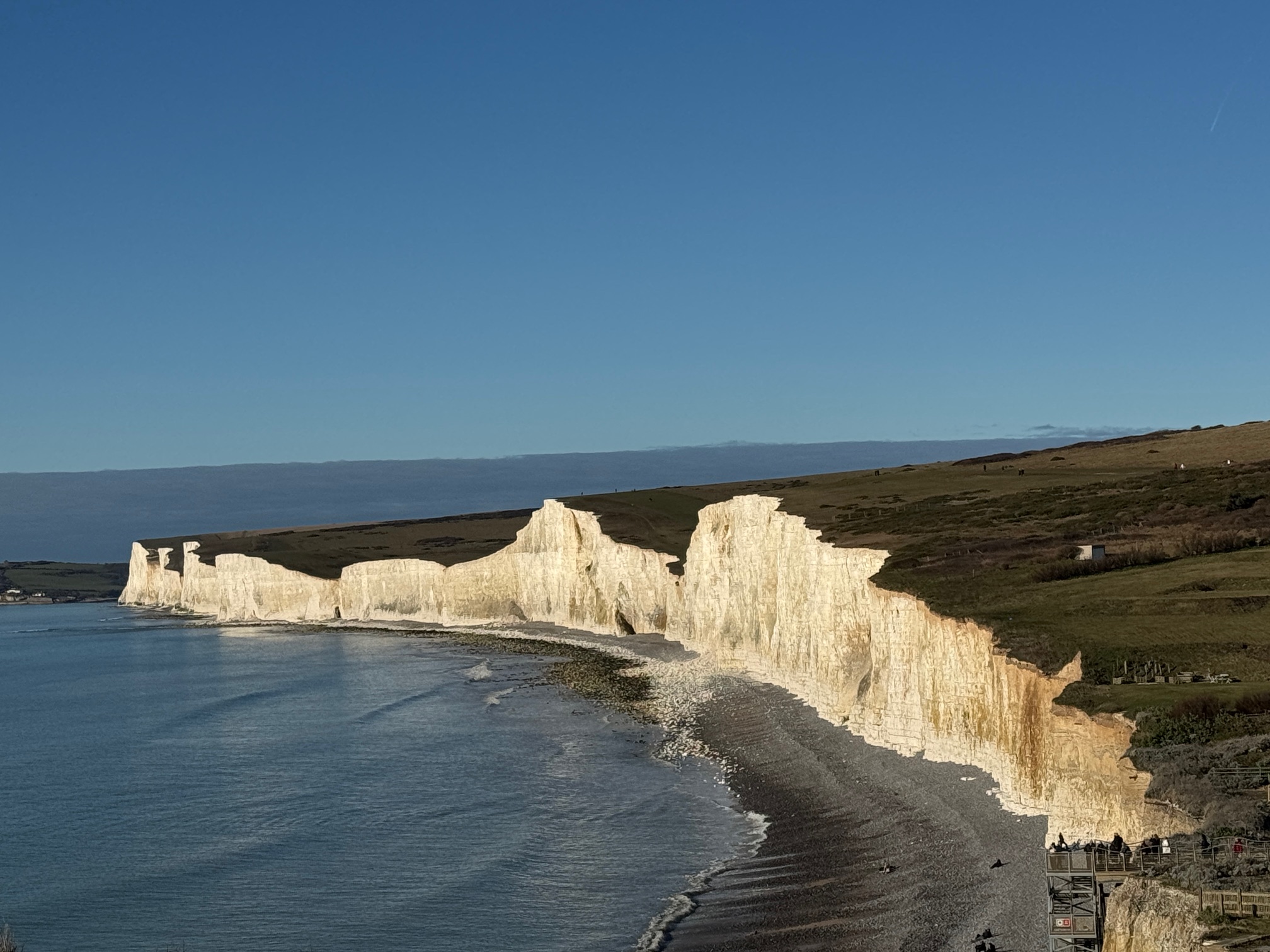
Seven Sisters Dog Walking Guide: Best Routes, Beach Access & Lead Rules
Dogs are welcome year-round on the Seven Sisters paths and beaches. No seasonal restrictions, no permits required, just turn up and walk. But—and this is important—you need to plan properly. We've done 100+ dog walks here over 5 years, and we've learned what works and what doesn't the hard way.
✓ Dogs Love:
- • Beach access at Cuckmere Haven (swimming!)
- • Valley floor walks (flat, sniff-friendly)
- • Off-lead running when safe
⚠️ Critical:
- • No water on 8km ridge walk
- • Leads required near livestock
- • Bring 1-2L water per dog
✗ Dogs Hate:
- • Ridge walk (too challenging for most)
- • 83 steps at Birling Gap
- • Hot summer midday walks
Lead Requirements & Rules
This is straightforward but crucial: know where leads are mandatory, where they're optional, and why. We've seen too many dogs chase sheep, get too close to cliff edges, or cause problems that could have been avoided with basic lead discipline.
❌ Leads MANDATORY (No Exceptions)
Near Cliff Edges
Common sense but needs saying: dogs don't understand 100m drops. We've seen dogs run straight at cliff edges chasing seagulls. Keep them on lead within 10m of any edge.
Around Sheep & Cattle
Lambing season (April-May): Absolutely mandatory, £1,000+ fines for livestock worrying
Year-round: If you can see sheep or cattle, dog should be on lead. Doesn't matter if your dog "doesn't chase"—the sheep don't know that and will panic.
Cuckmere Haven Beach (March-July)
Nesting season for ground-nesting birds. Dogs must be on lead on the beach itself. Valley paths fine for off-lead if good recall.
✓ Off-Lead Acceptable (If Well-Behaved)
Open Clifftop Paths
When there's no livestock visible, path is wide, and dog has good recall. Stay away from cliff edges. We let ours off-lead here but watch constantly.
Beach Areas (Outside Nesting Season)
Cuckmere Haven and Birling Gap beaches August-February: off-lead swimming paradise. Just watch for other dogs and people.
Cuckmere Valley Floor
Flat river paths, good visibility, usually no livestock. Perfect for off-lead walks if your dog won't chase wildlife.
💰 Fines for Livestock Worrying
This isn't theoretical. Farmers have the legal right to shoot dogs that are attacking or worrying livestock. Before it gets to that extreme, you'll face fines starting at £1,000. Even if your dog doesn't make contact, just chasing or barking at sheep counts as "worrying."
Our recommendation: Lead on whenever you see livestock. Off-lead at the beach. It's that simple.
5 Best Dog Walking Routes
Not all Seven Sisters routes work for dogs. The full ridge walk is brutal even for fit humans—most dogs struggle. These 5 routes are genuinely dog-friendly, tested extensively with our own dogs (and watching hundreds of others over the years).
1. Cuckmere Valley Circular
Distance: 5km • Duration: 1.5 hours • Difficulty: Easy
Start Point
Exceat car park (FREE parking)
Lead Required
Only near cattle (seasonal)
Water Access
River (check for algae warnings)
Why dogs love it: Completely flat, tons of interesting smells, river access for cooling off. This is the route we do with older dogs, puppies, or when it's too hot for anything challenging. The path loops through the valley floor following the old Cuckmere River meanders.
The route: From Exceat car park, head south toward the beach, then loop back via the western valley path. Entire route is on good paths, mostly grass. You can shorten it to 3km or extend to 7km depending on how far you walk toward the beach.
Our experience: This is perfect for 90% of dogs. No climbing, plenty of sniffing opportunities, other dogs to meet. Our 12-year-old collie can still do this comfortably. Water bowls at Exceat café when you finish.
2. Seaford to Hope Gap
Distance: 6km return • Duration: 2 hours • Difficulty: Moderate
Start Point
Seaford seafront (free street parking)
Lead Required
Cliff sections (safety)
Water Access
Beach at both ends
Why dogs love it: Beach start, adventure in the middle, beach finish. Swimming at both ends if weather permits. One solid climb to Seaford Head (150m elevation) which most fit dogs handle fine.
The climb: 45 minutes from Seaford beach to Seaford Head summit. Steep in places but good path. Keep dog on lead here—cliff edge drops are serious. From the summit, it's easier clifftop walking to Hope Gap.
Best for: Medium to large dogs with good energy. Our springer spaniel loves this—enough challenge to be interesting, beach reward at the end. Not suitable for small dogs or those with joint issues.
3. Birling Gap Beach Loop
Distance: 3km • Duration: 1 hour • Difficulty: Easy-Moderate
Start Point
Birling Gap car park (£5/day)
Lead Required
On steps, car park, and clifftop
Water Access
Sea (bring freshwater—saltwater unsafe)
Why dogs love it: Beach! Rock pools! Waves! This is the beach walk—down 83 steps to the beach, along the shore, back up. Short but dogs absolutely love the beach time.
The challenge: Those 83 steps. Down is fine for most dogs. Up is harder—large dogs especially can struggle. We've carried a tired Labrador back up (not recommended). Older dogs with joint issues should skip this.
Beach time: Check tide times. Low to mid tide gives maximum beach. High tide leaves barely any space. Off-lead on beach outside nesting season (August-February).
4. Exceat to Cuckmere Haven Beach
Distance: 4km return • Duration: 1.5 hours • Difficulty: Easy
Start Point
Exceat car park (FREE)
Lead Required
Near grazing animals, on beach Mar-Jul
Water Access
River and sea—perfect for swimming
Why dogs love it: If your dog swims, this is paradise. Flat 20-minute walk to the beach, then river and sea access. We've spent entire afternoons here watching dogs play in the shallow river mouth.
Perfect for hot days: Summer walks here are brilliant—easy morning stroll, dogs swim for an hour, back to car park. Bring towels. Your car will smell like wet dog (worth it).
Swimming safety: River mouth is shallow and safe. Sea beyond is tidal with currents—keep dogs close to shore. Most dogs stick to the river naturally (easier swimming, less salty).
5. Short Ridge Section
Distance: Variable 2-4 hours • Difficulty: Challenging
Honest assessment: They don't love it. This is for very fit, experienced hiking dogs only. The full ridge walk is seven 100m climbs over 8km. We've seen dogs struggle, refuse to continue, and exhaust themselves.
If you attempt this: Do just one or two peaks, not the full ridge. Bring 2L water per dog minimum. There's ZERO water access on the ridge—no streams, no ponds, nothing. Watch for overheating, especially in summer.
Our verdict: Only do this with young, very fit dogs who regularly do mountain walks. Even then, pick a cool day. For 95% of dogs, stick to routes 1-4.
Water Sources & Facilities
🚨 CRITICAL: No Water on Ridge Walk
This catches people out constantly. The ridge walk from Birling Gap to Cuckmere Haven is 8.2km with ZERO water access. No streams, no taps, nothing. We've seen dehydrated dogs being carried down—don't let that be yours.
Bring minimum 1L per dog, more in summer. 1.5-2L safer. Not optional.
Water Sources
Cuckmere River
Sometimes okay for dogs to drink, but check for algae warnings (posted at Exceat). Blue-green algae is toxic—don't risk it if warnings are up.
Sea Water
Not drinkable. Causes vomiting, diarrhea, makes dehydration worse. Bring freshwater always.
Cafés
Birling Gap café has water bowls outside. Exceat café is dog-friendly with outdoor seating, water available.
Dog-Friendly Facilities
Birling Gap
Water bowls, dog waste bins, dogs allowed in outdoor café area. £5 parking, fills early weekends.
Exceat Visitor Centre
Water available, dog-friendly café seating outside, waste bins. Free parking.
Nearest Vet
Drove Veterinary Hospital, Newhaven (8km). Emergency: 01273 515456. Save this number before you walk.
Seasonal Considerations
🌸 Spring (April-May)
Lambing season: Leads mandatory near all sheep. Farmers are extra vigilant, fines strictly enforced. Sheep with lambs will panic easily—give them wide berth.
Beautiful walking weather (12-16°C), paths can be muddy after rain. Wildflowers everywhere. Good time for dog walks.
☀️ Summer (June-August)
Heat exhaustion risk: 20°C+ days are dangerous for dogs. Early morning walks only (before 9am). Afternoon walks in full sun can be fatal for some breeds.
Strategy: 7am start, beach swim at Cuckmere Haven, home by 11am. Avoid midday completely.
🍂 Autumn (September-October)
Ideal conditions: 14-18°C, cooler mornings, comfortable all-day walking. This is genuinely the best time for dog walks here.
Less crowded (schools back), paths still mostly dry, no heat stress. Our favorite season for bringing dogs.
❄️ Winter (November-March)
Very muddy paths: 2-3 days after rain, paths turn to ankle-deep Sussex mud. Destroys dogs (and your car interior). Bring multiple towels.
Cold (6-10°C) + wind chill. Short-haired dogs may need coats. Empty trails, dramatic weather, good for hardy dogs.
🐦 Nesting Season (March-July)
Cuckmere Haven beach: dogs must be on lead. Ground-nesting birds are protected. Off-lead in valley paths is still fine, just not on the beach itself. Respected by most dog walkers we've seen.
What to Bring: Complete Checklist
✓ Essentials (Non-Negotiable)
-
1.
Strong Lead
Non-extendable preferred. Retractable leads near cliffs are dangerous. We use 2m fixed leads.
-
2.
Poo Bags (Minimum 4)
Bins available but widely spaced. Carry out if necessary. No excuses.
-
3.
Water (1-2L)
1L minimum per dog, 1.5-2L in summer. Plus collapsible bowl.
-
4.
Treats / Recall Rewards
High-value treats for recall training, rewarding good behavior around livestock.
-
5.
First Aid Kit
Paw injuries from flint are common. Bandages, antiseptic wipes, tweezers minimum.
-
6.
Towel(s)
Beach swimming, muddy paths, wet grass. Minimum 2 towels—one won't cut it.
+ Optional But Useful
-
•
High-Vis Vest
Clifftop safety, especially winter/dusk walks. Makes dog visible from distance.
-
•
Portable Fence/Tie-Out
If combining walk with picnic. Secure dog while you eat.
-
•
Tick Removal Tool
Grass ticks common in summer. Check dog after walks.
-
•
Dog Coat (Winter)
Short-haired breeds struggle in cold wind. Greyhounds especially.
Common Problems & Solutions
Sheep Chasing
Lead on, no exceptions. Even if "they never chase"—there's a first time for everything, and the consequences are severe (fines, dog destroyed, sheep killed).
If your dog shows interest in livestock, work on recall training BEFORE attempting these walks.
Paw Injuries from Flint
Chalk paths have sharp flint embedded. Dogs with soft pads can cut themselves. Check paws regularly during walk.
Solution: Dog boots if your dog tolerates them. Or build up paw calluses gradually over multiple shorter walks.
Heat Exhaustion
Dogs overheat faster than humans. Panting heavily, drooling excessively, wobbly walking = emergency.
Prevention: Early starts (before 9am), frequent water breaks, shade breaks, cut walk short if dog shows stress. Never push through.
Cliff Edge Curiosity
Dogs don't understand cliff danger. Keep on lead near edges always. We've seen dogs run straight at edges chasing seagulls.
If dog slips over: DO NOT jump after them. Call 999 coastguard immediately. Horrible but true.