Seven Sisters
FAQ
Is Seven Sisters a National Nature Reserve? Free to visit? How long is the walk? Train times from London? Wildlife, parking, dogs, swimming, drones - all answered.
Is Seven Sisters a National Nature Reserve? Free to visit? How long is the walk? Train times from London? Wildlife, parking, dogs, swimming, drones - all answered.
Everything you need to know before visiting Seven Sisters
Yes. Seven Sisters was officially designated a National Nature Reserve by King Charles III on 19 March 2026 — the 13th in his planned series of 25 reserves. It protects over 1,500 hectares of chalk downland, Heritage Coast, and wildlife habitat between Seaford and Eastbourne in East Sussex. The designation means the site now has the highest level of nature protection in England.
Yes, walking the cliffs is completely free. Car parking is paid at Birling Gap (tiered: £2–£8, NT members free) and at Exceat (~£7/day). Free parking is available at Foxhole Bottom, Friston village, and South Hill Barn, Seaford (BN25 4JQ). There are no entry fees, tickets, or permits required.
The full ridge walk from Seaford to Eastbourne takes 6-7 hours (21.9km). Most visitors do shorter walks: Exceat to Birling Gap (2-3 hours, 6.5km), Cuckmere Haven beach walk (1 hour, 3km), or Birling Gap short loop (45 minutes, 2km). Choose based on your fitness level and available time.
Yes, dogs are welcome but must be kept on leads near sheep (April–October) and under close control at all times. The steep terrain can be challenging for small dogs. There's no water on the ridge — bring plenty of water for your dog. Clean up after your pet. Dogs are not allowed in some cafés but outdoor seating is usually dog-friendly.
Partially. Birling Gap has an accessible clifftop viewing platform with spectacular views and accessible toilets. The Cuckmere Haven riverside path is also wheelchair-friendly. However, the main ridge trails are not accessible due to steep gradients, uneven chalk surfaces, and narrow paths. Contact Seven Sisters Country Park (01323 870280) for detailed accessibility information.
Yes, at Birling Gap beach. The water is cold year-round (10 – 16°C) and currents can be strong. There are no lifeguards. Check tide times before visiting — the beach disappears completely at high tide. Swimming is only safe 2 hours before to 2 hours after low tide. Not recommended for inexperienced swimmers. Rocky seabed — wear water shoes.
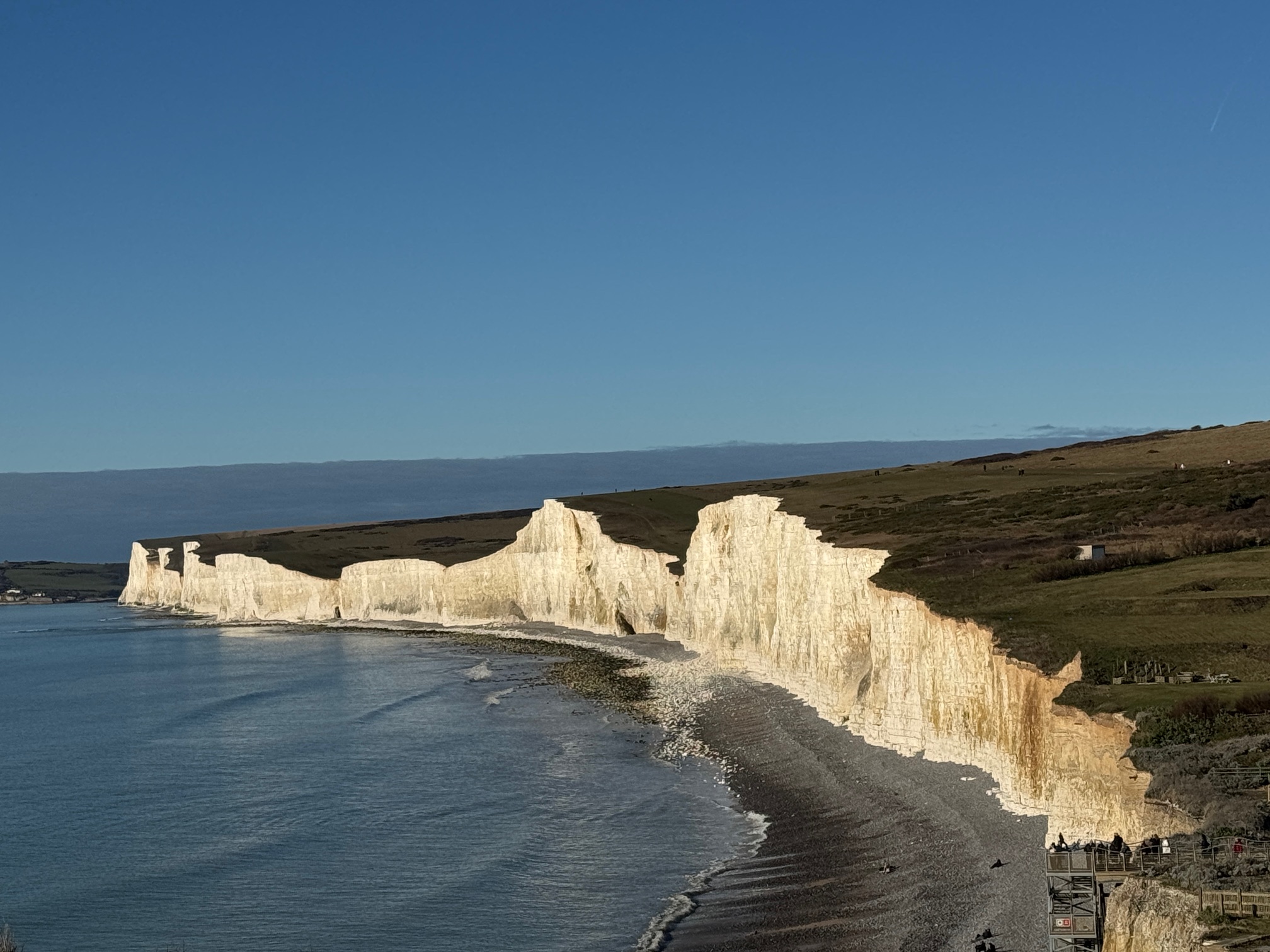
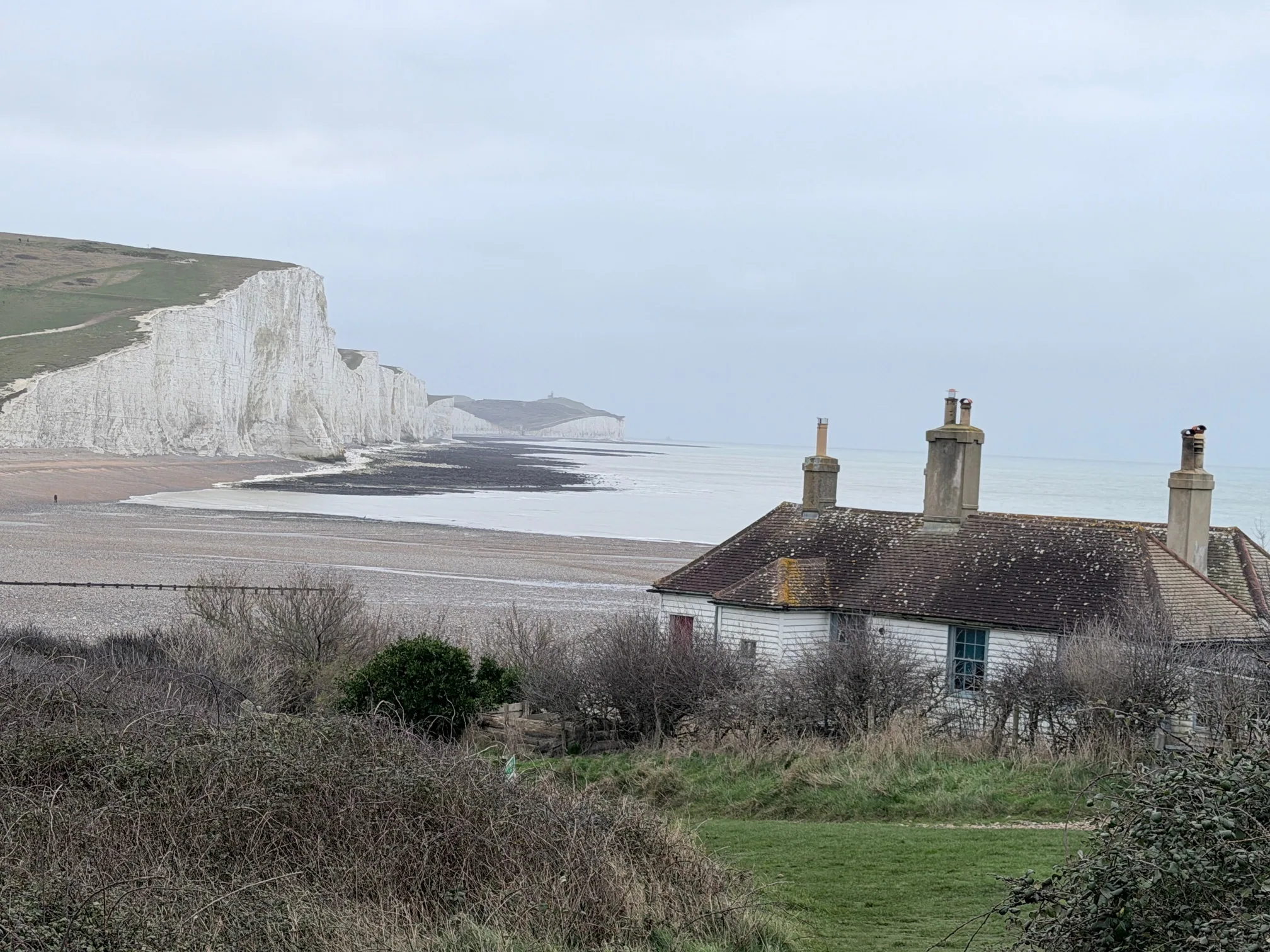
The seven chalk peaks run from west to east: Haven Brow, Short Brow, Rough Brow, Brass Point, Flagstaff Point, Bailey's Hill, and Went Hill Brow. They're best viewed from Seaford Head looking east, where all seven are visible in one panoramic view. Each peak is separated by a valley, creating the distinctive undulating clifftop profile.
No, wild camping is illegal on National Trust and National Park land. Fines start at £100. The nearest official campsite is Alfriston Camping Park, about 5km inland. For accommodation, consider hotels and B&Bs in Eastbourne, Seaford, or Alfriston village. Beachy Head Hotel is the closest to the cliffs.
They're 80km apart on different parts of the Sussex/Kent coast. The Seven Sisters peak at around 77 metres while Dover's cliffs reach about 110 metres — so Dover is taller. But the Seven Sisters are more undulating, more dramatic to walk, and completely undeveloped with no buildings or roads visible. Dover's cliffs are more famous internationally; Seven Sisters offer the better clifftop walking experience.
Patchy. EE and Vodafone work better than O2 or Three. Signal drops to zero in valleys between peaks. Download offline maps (OS Maps app recommended) before you arrive. Don't rely on your phone for navigation. Bring a paper map or download routes in advance. In emergencies, move to higher ground for better signal.
No. The entire Heritage Coast is a drone exclusion zone under CAA (Civil Aviation Authority) regulations. This includes all remote-controlled aircraft and UAVs. Fines up to £2,500 apply for violations. The ban protects wildlife, visitor safety, and preserves the peaceful environment. Use telephoto lenses for aerial-perspective photography instead.
Take Southern trains from London Victoria to Seaford (1 hour 25 minutes, approximately £22 return off-peak) or Eastbourne (1 hour 30 minutes). From Seaford station it is a 60-minute walk or a 15-minute bus ride to the Exceat visitor centre. From Eastbourne, the seasonal 13X bus runs to Birling Gap. No car is needed — the train is often faster and cheaper than driving and parking.
Seven Sisters National Nature Reserve supports exceptional wildlife. On the cliffs look for peregrine falcons, kittiwakes, and fulmars. On the downland above listen for skylarks and yellowhammers. Along the Cuckmere River you may spot kingfishers, grey herons, teals, and oystercatchers. The chalk grassland hosts over 30 species of wildflower including pyramidal orchids and horseshoe vetch. Spring (April–May) is best for birds and flowers; autumn brings migrating species.
The chalk cliffs erode at approximately 30–50 centimetres per year on average, though erosion is highly irregular. Large sections can collapse without warning, particularly after storms or prolonged rain when water saturates the chalk. This is why the clifftop path is regularly rerouted inland and visitors must stay well back from the cliff edge at all times. The erosion is natural, cannot be stopped, and is part of what keeps the chalk gleaming white.
September to early October gives the best weather-to-crowd ratio: summer warmth lingers (16–19°C), school holidays are over, and the autumn light is spectacular. Spring (April–May) is best for wildflowers, green cliff tops, and photography. Avoid late July and August weekends when Birling Gap car park fills by 9:45am. Winter (November–March) is cold and muddy but offers solitude and dramatic skies. See our full seasonal timing guide for detailed advice.
The Seven Sisters take their name from the seven distinct chalk cliff peaks that rise in sequence between Cuckmere Haven and Birling Gap. The individual peaks are named (west to east): Haven Brow, Short Brow, Rough Brow, Brass Point, Flagstaff Point, Bailey's Hill, and Went Hill Brow. The 'sisters' metaphor likely comes from how the peaks appear in family-like sequence — similar in shape but each with its own character. The name appears in written records from the 19th century and is thought to originate from local Sussex fishing communities who used the distinctive cliff sequence as a navigation landmark from sea.
The Seven Sisters cliffs are made of chalk — a soft white limestone composed of approximately 97% calcium carbonate. The chalk formed around 85 million years ago (the Seaford Chalk Formation) during the Late Cretaceous period from the compressed shells of coccolithophores (microscopic marine algae) that lived in a warm, shallow tropical sea covering what is now southern England. The white colour comes from the purity of the calcium carbonate. The dark horizontal bands visible in the cliff faces are layers of flint, formed from silica that concentrated within the chalk as it solidified. For a deeper explanation, see our geology guide.
Yes. Fatalities have occurred at Seven Sisters, primarily from cliff-edge falls caused by standing on unstable ground, and from tide incidents on the beach below the cliffs. The chalk cliff edge is unpredictable — the ground can collapse without warning, and overhangs are not visible from above. The 5-metre rule (stay at least 5 metres from the cliff edge at all times) is not optional. HM Coastguard and the RNLI respond to incidents here regularly. Treat the cliff edge with the same seriousness as any mountain environment. See our complete safety guide before you visit.
Yes — two main beach access points. At Birling Gap, 83 steps lead down to a shingle and chalk platform beach directly below the cliffs, with chalk walls rising up to 75 metres above you. At Cuckmere Haven, a flat walk from Exceat car park leads to a wider shingle estuary beach where the Cuckmere River meets the sea — accessible for all fitness levels and offering the iconic view of the Seven Sisters from sea level. Both beaches are tide-dependent: the Birling Gap beach disappears at high tide. Check tide times before visiting.
No — there is no recommended crossing of the river mouth at any state of the tide. Seven Sisters Country Park, the South Downs National Park Authority and HM Coastguard all urge walkers not to cross: the water is tidal, cold and fast-flowing, with uneven depths that change as the river meets the incoming tide, and there are no lifeguards. Some walkers do cross at low water, but no official body publishes a safe crossing point or a safe time, and neither does this site. The only crossing is Exceat Bridge, the A259 road bridge by the Cuckmere Inn and the visitor centre — roughly 4 km (about an hour) of flat valley walking between the Coastguard Cottages side and the foot of Haven Brow, and the route every published Seven Sisters walk uses. Why we hold that line: crossing the Cuckmere at low tide · tide safety.
We may earn a small commission on bookings made through this link, at no extra cost to you. More info.
For real-time conditions, tide times, or specific access questions, contact the visitor centres:
Exceat, BN25 4AD
Open 10am-4pm daily
Tel: 01323 870280
Birling Gap, BN20 0AB
Open 9am-5pm (café hours)
Tel: 01323 423197
Most questions on this page come down to one thing — which of the four routes you pick. Compare distance, ascent and difficulty side by side.
Practical guides to help you plan your Seven Sisters visit.
£4.99 · 24-page PDF · Instant download
The complete 24-page companion built from first-hand walks — every cliff, all four graded routes, tide windows and a parking strategy. Designed to work offline, right on the cliff top.
Just want the basics? Download the free 2-page walk guide
Stay up to date with seasonal guides, crowd forecasts, and local tips — direct to your inbox.
No spam. Only coastal inspiration and timing tips — unsubscribe any time.