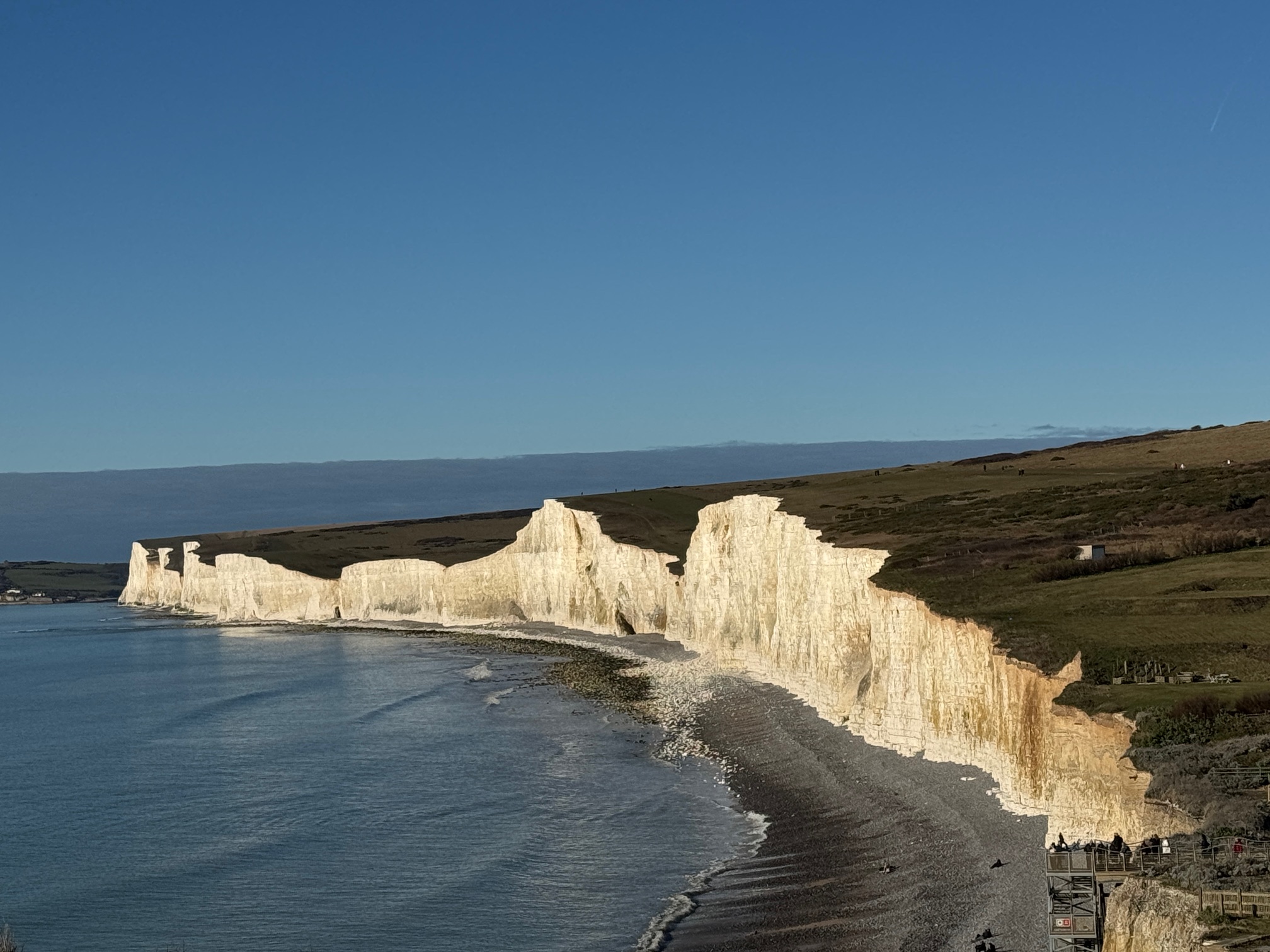
Seven Sisters Geology: How Chalk Cliffs Form, Erode, and Change
The Seven Sisters are 100 million years old, made of compressed marine skeletons, and eroding at roughly one metre per year. These white chalk cliffs aren't rock in the traditional sense—they're biological sediment, the accumulated remains of trillions of microscopic organisms that lived and died in a warm, shallow sea that covered southern England during the Cretaceous period.
I'm not a geologist, but walking the Seven Sisters repeatedly makes you curious about what you're looking at. Understanding the geology changes how you see these cliffs—not just as scenic landmarks, but as a 100-million-year record of ancient life, climate, and geological processes still actively reshaping the coast.
What Is Chalk?
Chalk is a soft, white limestone made almost entirely from the calcium carbonate shells of coccolithophores—single-celled algae that lived in vast numbers in warm, shallow seas. When these organisms died, their shells drifted to the seabed and accumulated over millions of years. Pressure from overlying sediment compressed these layers into the chalk rock you see today.
The purity of chalk means the sea was clear, warm, and relatively shallow—deep enough to support marine life but not so deep that other sediments (mud, sand, clay) were deposited. This indicates stable environmental conditions lasting millions of years, which is why chalk deposits are so thick.
The numbers: The Seven Sisters chalk is roughly 100 million years old, formed during the Late Cretaceous period. The cliffs reach 162 metres at their highest point (Beachy Head). Each metre of chalk represents thousands of years of accumulation—the entire sequence spans about 10-15 million years.
How the Cliffs Formed
The chalk was deposited on the seabed during the Cretaceous period (145-66 million years ago) when southern England was submerged beneath a warm, tropical sea. This sea was part of a larger ocean that connected to the North Atlantic and extended across much of Europe.
After the chalk was deposited, several geological events shaped what we see today:
1. Uplift: Around 65 million years ago (coinciding with the end of the dinosaurs), tectonic forces pushed the chalk seabed upward, creating the Weald-Artois ridge. This uplift raised the chalk above sea level, forming dry land.
2. Folding: The same tectonic forces that created the Alps also gently folded the chalk, creating the gentle dip and tilt visible in the cliff faces. The Seven Sisters undulating ridge reflects these ancient folds.
3. River erosion: For millions of years, rivers eroded the uplifted chalk, creating valleys and wearing away softer rock. The Cuckmere Valley was carved by the River Cuckmere over thousands of years.
4. Sea level rise: At the end of the last Ice Age (around 10,000 years ago), melting glaciers raised sea levels, flooding the English Channel and creating the modern coastline. The rising sea undercut the chalk, forming the steep cliffs we see today.
Why Chalk Cliffs Are White
The brilliant white colour comes from the calcium carbonate (lime) that makes up the chalk. This is the same compound found in limestone, marble, and seashells. The purity of the chalk—nearly 95% calcium carbonate—creates the intense white colour.
In contrast, other cliffs contain impurities (iron oxides, clay, organic material) that create yellows, browns, reds, or greys. The Seven Sisters chalk is exceptionally pure, indicating the ancient sea was clear and free from mud or silt washed in from land.
Colour variations: Fresh chalk exposed by recent rockfalls is brilliant white. Older exposed surfaces weather to off-white or light grey as rainwater dissolves some calcium carbonate and organic material accumulates. After heavy rain, the cliffs look cleaner and whiter as surface dirt washes away.
Flint Layers in the Chalk
If you look closely at the cliff faces, you'll see horizontal dark bands running through the white chalk. These are flint layers—hard, glassy nodules of silicon dioxide that formed within the chalk.
Flint forms when dissolved silica (from sponge spicules and other silica-rich organisms) precipitates out of solution within the chalk sediment. Over time, this silica concentrates into hard nodules and layers. Flint is much harder than chalk, so it resists erosion better—you'll often see flint nodules protruding from eroded chalk faces or littering the beach.
Practical use: For thousands of years, humans used flint from these cliffs to make tools, weapons, and later, for building. Many old Sussex buildings incorporate flint in their walls. The beach at Birling Gap is covered in flint nodules eroded from the cliffs.
Fossils in the Chalk
The chalk is full of fossils—remnants of the marine life that inhabited the Cretaceous sea. Most fossils are microscopic (the coccolithophores that form the chalk itself), but you can find visible fossils if you know what to look for.
Common fossils at the Seven Sisters:
- Echinoids (sea urchins): Round, often flattened fossils with a distinctive five-pointed pattern. These are the most commonly found fossils on the beach.
- Belemnites: Bullet-shaped fossils from squid-like creatures. They're the internal shell of the animal, made of calcite.
- Brachiopods: Small shell fossils, often ribbed or curved. These look like clams but are a different group of animals.
- Sponges: Less common, but you'll occasionally find sponge fossils preserved in the chalk.
- Ammonites: Rare in the Seven Sisters chalk, but occasionally found. These are spiral-shelled cephalopods related to modern nautilus.
Finding Fossils
- Where to look: The beach at Birling Gap, especially after recent rockfalls. Fresh chalk from cliff falls often contains visible fossils.
- Don't climb or dig: Never hammer the cliffs or climb on unstable chalk. Only collect fossils from loose material on the beach.
- Legal note: You're allowed to collect small fossils for personal use from the beach, but not from the cliff faces themselves (the cliffs are protected).
- What to bring: Just your eyes. Fossils weather out of the chalk naturally. If you want to collect, bring a small bag for loose specimens.
How Erosion Works
The Seven Sisters erode quickly—roughly one metre per year on average, though the rate varies. This erosion is faster than most rock cliffs because chalk is soft and porous, making it vulnerable to weathering and wave action.
The erosion process:
1. Wave action: Waves undercut the base of the cliff, creating an overhang. This is most effective during storms when powerful waves pound the cliff base.
2. Freeze-thaw weathering: Water seeps into cracks and pores in the chalk. When it freezes, it expands, widening cracks and weakening the rock. Repeated freeze-thaw cycles fracture the chalk.
3. Rain and groundwater: Rainwater dissolves chalk (calcium carbonate is slightly soluble in acidic rainwater). Groundwater flowing through the chalk weakens it and increases weight, destabilizing the cliff.
4. Rockfalls: Once the overhang becomes too heavy or the supporting cliff base is undercut, sections collapse in rockfalls. These can be small (a few tonnes) or massive (thousands of tonnes). The fallen chalk accumulates at the cliff base, temporarily protecting it from wave action until the sea removes the debris.
Stay back from cliff edges: Erosion is unpredictable. The clifftop path is set back from the edge for safety, but people ignoring warnings and approaching the edge have fallen to their deaths. Cracks opening behind the cliff edge indicate instability—never cross warning signs or fences.
Why the Cliffs Are Striped
Looking at the Seven Sisters, you'll notice the white chalk isn't uniform—there are subtle horizontal bands and colour variations. These reflect changes in the ancient environment when the chalk was deposited:
- Marl seams: Thin grey or greenish layers of clay-rich chalk. These formed when mud from land occasionally washed into the sea, mixing with the chalk sediment.
- Flint bands: Dark layers of flint nodules running horizontally through the chalk.
- Hardgrounds: Cemented layers where the seabed was temporarily exposed, allowing minerals to precipitate and harden the chalk.
These variations help geologists correlate chalk layers across different locations and reconstruct ancient sea level changes and climate shifts.
The Cretaceous Environment
Walking the Seven Sisters, you're looking at the remains of a warm, shallow sea that bore no resemblance to the English Channel today. During the Cretaceous period when this chalk was forming:
- Sea levels were much higher—most of Britain was underwater
- The climate was warmer—tropical or sub-tropical with no ice caps
- Marine reptiles (plesiosaurs, mosasaurs) swam in these waters
- Ammonites, belemnites, and ancient fish were common
- The nearest land was hundreds of kilometres away
- No grass existed yet (grass evolved later, around 60 million years ago)
The chalk you walk on is a snapshot of this alien world—compressed into rock and raised above the sea by tectonic forces.
Erosion Rates and Coastal Change
The Seven Sisters are not permanent. Erosion is continuously reshaping the coastline, and what you see today will look different in 50 or 100 years.
Historical erosion: Comparing old photographs and maps shows significant change. The clifftop path has been rerouted multiple times as sections collapse. Birling Gap's row of coastguard cottages originally stood 50 metres from the cliff edge—by 2014, several had to be demolished as the sea reached them.
Future change: At current erosion rates, the Seven Sisters will retreat inland by 100 metres over the next century. The distinctive undulating profile will persist (the valleys between cliffs erode at similar rates to the clifftops), but the entire ridge will shift inland.
Perspective: Since the Seven Sisters formed as cliffs 10,000 years ago, they've retreated roughly 10 kilometres inland. The coast once extended far out into what's now the English Channel. The erosion you see happening today has been continuous throughout human history.
Geology You Can See
Specific geological features visible from the clifftop path or beach:
The Seven Sisters undulations: These reflect gentle folds (anticlines and synclines) in the chalk. The valleys are synclines (downfolds), the clifftop peaks are anticlines (upfolds). This folding happened when the chalk was compressed by tectonic forces around 30 million years ago.
Cliff stratification: Horizontal layers visible in the cliff faces show the original bedding planes—the layers of sediment deposited on the seabed. These layers tilt slightly (dipping gently to the north), evidence of the folding that created the South Downs.
Rock debris at cliff base: Fresh white chalk blocks indicate recent rockfalls. Older debris is grey and weathered. The beach at Birling Gap is made almost entirely of eroded chalk and flint from the cliffs.
Dry valleys: The valleys between the Seven Sisters peaks are dry (no streams). These formed during the Ice Age when frozen ground prevented water from soaking into the chalk, causing meltwater to carve valleys. Today, rainwater soaks into the porous chalk before it can form streams.
Comparing Chalk to Other Rock
Chalk is unusual as a cliff-forming rock:
- Softer than most cliffs: You can scratch chalk with your fingernail. Compare this to granite or basalt cliffs that are hard and crystalline.
- Faster erosion: Chalk erodes much faster than harder rocks, creating a dynamic coastline that changes noticeably within a human lifetime.
- Biological origin: Most cliffs are igneous (volcanic) or metamorphic (altered by heat/pressure). Chalk is sedimentary and biological—literally made of dead organisms.
- High porosity: Chalk absorbs water like a sponge, which increases erosion but also creates important groundwater reserves.
Why Geology Matters for Walking
Understanding the geology helps you walk more safely and appreciate what you're seeing:
Erosion means danger: Cliffs collapse without warning. Cracks parallel to the cliff edge indicate instability. Never approach the edge, even if it looks solid—the chalk can fail suddenly.
Mud after rain: Chalk is porous. After rain, the clifftop paths become slippery with chalky mud. The paths dry quickly, but steep sections stay muddy longer.
Beach composition: The beach is almost entirely chalk and flint. It's uncomfortable to walk on (rounded flints roll underfoot), and there's little sand. Understanding why helps set expectations.
Fossil hunting: Knowing where fossils come from (the chalk itself) and what to look for makes beachcombing more rewarding.
Geological Viewpoints
Best places to see Seven Sisters geology:
- Birling Gap beach: Close-up view of cliff stratification, fresh rockfalls, flint layers, and fossil hunting.
- Seaford Head: Looking east toward the Seven Sisters shows the undulating profile and geological structure clearly.
- Beachy Head lighthouse viewpoint: The cliff face shows clear chalk stratification and the massive scale of the cliffs.
- Cuckmere Haven: Looking up at the Seven Sisters from sea level shows the cliff height and erosion patterns.
Ongoing Research
Geologists continue studying the Seven Sisters to understand chalk cliff erosion, climate change impacts, and coastal evolution. Research includes:
- Laser scanning to measure erosion rates precisely
- Studying how climate change and sea level rise affect erosion
- Understanding rockfall triggers (weather, wave action, groundwater)
- Predicting future coastal change
This research helps manage coastal defences elsewhere (though the Seven Sisters are deliberately left to erode naturally) and improves understanding of how soft rock coasts respond to environmental change.
Explore More
For walking routes that showcase Seven Sisters geology, see our walking guides. Our Birling Gap beach guide covers fossil hunting and safe beach access. For understanding weather impacts on erosion, see our weather patterns guide.