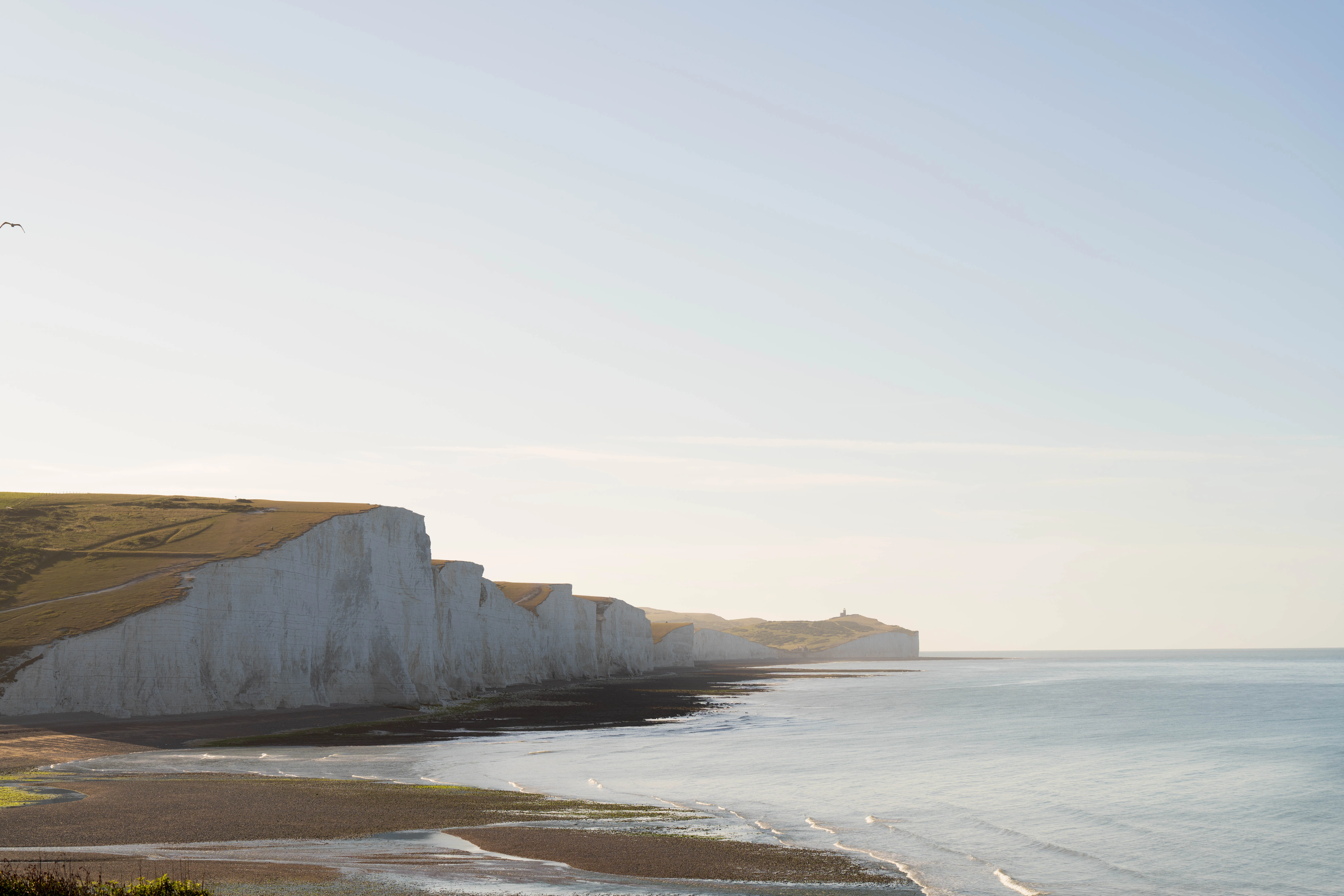
Seven Sisters Flora: Wild Orchids & Chalk Plants Guide
Most people walk the Seven Sisters and see grass. Which is understandable — the chalk clifftop looks like a lawn from a distance. But crouch down and look closely in May, June, or July and something else is happening entirely. Six species of wild orchid grow here. Several chalk-specialist plants occur on this site and practically nowhere else in England. What looks like unremarkable turf is, to a botanist, one of the most interesting square kilometres in the country.
You don't need to be a botanist to appreciate it. You just need to know what to look for and when.
Why Chalk Grassland Is Botanically Special
The Chalk Soil Challenge
Chalk is not fertile soil. It's alkaline (high pH), nutrient-poor, and thin. In most places, such soil would support minimal vegetation. Farmers have traditionally avoided chalk soils for cultivation because they're unreliable for crops. This "uselessness" for agriculture created an unexpected conservation benefit—chalk grassland was never cleared for farming (unlike most of England's lowland grasslands, now gone). This preservation created the botanical haven that exists today.
The plants thriving here are specialists. They've evolved to extract maximum nutrition from poor soil, to withstand chalk's alkalinity, and to survive on steep slopes where deeper-rooted competitors can't persist. This selective pressure created a unique plant community found nowhere else.
Mediterranean and Continental Species in England
Seven Sisters' chalk grassland supports Mediterranean and continental European plants at their northernmost range limits. Several species are found in England only on chalk grasslands in southern counties. Some are found on Seven Sisters and literally nowhere else in England (or are extremely rare elsewhere). This rarity is conservation significant—damage to Seven Sisters grassland directly threatens species survival.
The Orchid Connection
Orchids are indicator species. Their presence signals a healthy, undisturbed chalk grassland ecosystem. Conversely, grassland degradation shows immediately in declining orchid diversity and abundance. Seven Sisters orchid populations are monitored annually as a health indicator for the entire ecosystem. When orchid numbers decline, conservation concern rises because it signals broader ecosystem stress.
Seven Sisters Chalk Grassland Plants
Common Chalk Grassland Species
Grasses (foundation of the ecosystem): Rather than specific turf grass, chalk grassland is a community of grass species. Chalk Milkwort, Blue Fescue, Tor-grass, and Upright Brome create the turf structure. These aren't showy, but they're essential. The grazing patterns of plants and the turf structure they create determine the entire plant community composition.
Distinctive forbs (non-grass flowering plants):
- Marjoram: Aromatic herb with purple-pink flowers (July-September). Very common on chalk grassland. Fragrant when brushed against.
- Wild Thyme: Low-growing groundcover with pink-purple flowers (May-September). Again aromatic. Bumblebees love it.
- Lady's Bedstraw: Tall herb with tiny bright yellow flowers (June-September). Not dramatic but numerous and cheerful.
- Salad Burnet: Delicate fern-like foliage with tiny reddish flowers (May-August). One of the most delicate-looking grassland plants.
- Horseshoe Vetch: Yellow flowers in distinctive horseshoe shape (May-July). The sole food plant for Adonis Blue butterfly caterpillars—its presence is essential for that spectacular butterfly's survival.
- Chalk Milkwort: Delicate blue flowers (June-July). Another delicate beauty distinctive to chalk.
Rare Chalk Specialists
Bee Orchid relatives and allies: Though the famous Bee Orchid isn't found at Seven Sisters (it prefers warmer southern chalk downs), several related species are present. These will be detailed in the orchid section below.
Burnt Orchid (Neotinea ustulata): If you see a distinctive flower spike topped by tiny reddish-brown buds (appearing burnt), this is Burnt Orchid. It's genuinely rare—found only in scattered locations on southern chalk. Seven Sisters is one of the few reliable locations. Peak bloom: May-June.
Bastard Toadflax (Thesium humifusum): Another genuine rarity at Seven Sisters. Tiny inconspicuous plant with minuscule greenish flowers. Easy to miss. Only a few locations in UK support it. Its presence at Seven Sisters matters for conservation.
Seven Sisters Wild Orchids: Detailed Guide
Introduction to Orchid Identification
Orchids at Seven Sisters are small (compared to tropical orchids you might imagine). They're typically 10-40 cm tall with delicate flowers arranged in spikes or clusters. Identification requires careful observation:
- Overall plant height and structure
- Leaf arrangement and shape
- Flower color and pattern
- Number of flowers on spike
- Lip shape (the modified lower petal) and markings
- Blooming time
Orchid identification is genuinely challenging. Guides, field identification courses, or accompaniment with experts is advisable for serious orchid observation.
Early Purple Orchid (Orchis mascula)
Blooming period: April-May (earliest of chalk grassland orchids)
Identification: Purple-pink flowers on a dense spike, typically 20-40 cm tall. The most common orchid at Seven Sisters. Relatively easy to identify due to distinctive purple colour and spike shape. Leaves are often marked with dark purple blotches (helpful identification feature).
Where to look: Throughout the grassland. Often clustered in slightly damper microhabitats. Frequently solitary, but sometimes clusters of 5-10 plants occur in optimal patches.
Habitat preference: Prefers slight dampness—often found near small seeps or in slightly lower areas of the grassland.
Pollination: Visited by specific bees and butterflies. Male insects are sometimes attracted to the flower, mistaking it for a female of their species (pseudocopulation); this interaction can result in pollination.
Photography tips: The purple colour photographs well with diffuse light (overcast is good). Shooting low from ground level, framing against sky or blurred background, creates dramatic images. The blotched leaves are distinctive—include them in close-ups.
Common Spotted Orchid (Dactylorhiza fuchsii)
Blooming period: May-July (later than Early Purple)
Identification: Pink-purple flowers on a relatively loose spike, 20-50 cm tall. Leaves have distinctive dark purple spots/blotches (hence "spotted"). The distinctive leaf pattern is the easiest identification feature. Multiple stems often emerge from one plant base.
Where to look: Prefers wetter microhabitats more consistently than Early Purple. Often found in seepage areas, damper hollows. Typically scattered rather than clustered.
Habitat preference: Distinctly prefers dampness. Absence of Common Spotted Orchid in dry areas is a reliable identification clue (Early Purple tolerates drier conditions).
Pollination: Visited by various long-tongued insects. More generalist than some orchids.
Photography tips: The spotted leaves are distinctive—photograph them close-up showing the pattern. The flower colour is pale compared to Early Purple—shooting on overcast days or in shade preserves the delicate tone (harsh sun makes them washed-out in photos).
Pyramidal Orchid (Anacamptis pyramidalis)
Blooming period: June-July (mid-season)
Identification: Distinctive dense pyramidal flower spike (hence the name), bright pink-purple flowers, 20-40 cm tall. The pyramid shape is quite recognizable. Relatively clean-looking flowers (no heavily patterned parts like some other species).
Where to look: Throughout grassland, but prefers relatively dry areas. Often on slightly elevated patches. Frequently solitary or widely scattered.
Habitat preference: Favours drier, well-drained microsites. This is one of the most drought-tolerant local orchids.
Pollination: Visited by butterflies and some moths. The flowers are arranged to facilitate long-tongued insect access.
Photography tips: The pyramidal shape is photographically distinctive. Shooting the entire flower spike shows the characteristic shape. The pink-purple colour photographs well in golden hour light (warm evening light complements the flower colour). Shooting slightly backlit emphasizes the flowers.
Fragrant Orchid (Gymnadenia conopsea)
Blooming period: June-July (mid-season, overlapping with Pyramidal)
Identification: Delicate, dense flower spike with tiny pink-purple flowers, 20-40 cm tall. Much more delicate-looking than Pyramidal (finer flowers, more open arrangement). The crucial identification feature is fragrance—literally scent the flowers. If they smell sweet and distinctive, it's likely Fragrant Orchid. (Not all individuals are strongly scented; older flowers lose scent.)
Where to look: Scattered throughout grassland. Often less common than Pyramidal, so finding them requires searching. Look for the delicate pale pink spikes.
Habitat preference: Not strongly tied to wet or dry habitats; found across range of conditions.
Pollination: Visited by specific butterflies (especially Chalkhill Blue butterfly). The flower's appearance, scent, and nectar attract these pollinators.
Photography tips: The delicate nature is hard to capture in photos—tend to photograph as pale spikes without obvious structure. Macro photography of individual flowers (really close-up, detailed view) shows the delicate beauty better than full spike photos. The fragrance, of course, isn't captured in photos—mention it in captions.
Fly Orchid (Ophrys insectifera)
Blooming period: May-June (early-season)
Identification: Small flowers (6-12 per spike), 15-35 cm tall. Flowers are extremely distinctive—they resemble small dark insects (hence the name). The "lip" (lower petal) is dark burgundy-brown with a bluish-gray sheen, appearing insect-like. Very unusual appearance unlike typical orchid flowers.
Where to look: Generally scattered, not clustered. Often in relatively dry areas. Sometimes overlooked because the flowers are small and the spike is not showy.
Habitat preference: Prefers relatively dry, warm microsites.
Pollination: This is the famous case of pseudocopulation—male insects (certain bee and wasp species) are attracted to the flower, mistaking it for a female of their species. The insect attempts to copulate with the flower; this interaction results in pollination. This is one of nature's most remarkable examples of plant-insect mimicry. The scent mimics female insect pheromones.
Photography tips: The insect-like appearance is the entire point. Close-up photography showing the detailed flower structure is essential. Macro photography (extreme close-up) is ideal. The burgundy-blue colouration photographs well with soft, diffuse light.
Man Orchid (Orchis anthropomorpha)
Blooming period: May-June (early-season)
Identification: Small flowers (5-20 per spike), 10-25 cm tall. Flowers vaguely resemble tiny human figures (hence the name), though the resemblance is subtle. Pale green-yellow flowers with reddish-brown markings. Quite distinctive once you know what to look for; subtle if you don't.
Where to look: One of the rarer orchids at Seven Sisters. Scattered in grassland but requires searching. Often overlooked because the flowers are small and pale.
Habitat preference: Not strongly tied to specific conditions; found across various microsites.
Pollination: Another pseudocopulation specialist—attracted to specific male insects via pheromone mimicry.
Photography tips: The subtle resemblance to human figures is easiest to capture in extreme close-ups. Wide shots of the plant miss this distinctive feature. Shooting multiple angles of individual flowers helps convey the quirky form.
Lesser Butterfly Orchid (Platanthera bifolia)
Blooming period: May-July (extended season)
Identification: 8-15 flowers per loose spike, 20-40 cm tall. Pale white or very pale green flowers with a distinctive long thin spur (a backward-pointing extension from the flower). The spur is the key identification feature—it's prominent and unusual-looking.
Where to look: Found in varying habitats, though prefers less-dense grassland areas. Often on gentle slopes or slightly damper areas.
Habitat preference: Moderately adaptable; found across range of conditions, though shows some preference for less-intensively-grazed areas.
Pollination: Visited by long-tongued insects (moths, some bees). The spur holds nectar accessible only to long-tongued pollinators.
Photography tips: The spur is the most distinctive feature—photograph it clearly (side-on view best shows the long spur). The pale flowers photograph well against darker backgrounds or with backlighting. The flowers are delicate and photograph better with diffuse light than harsh direct sun.
Orchid Blooming Timeline and Watching Strategy
April-May: Early Purple Orchid, Fly Orchid, Man Orchid, Lesser Butterfly Orchid begin blooming.
May-June: All species are present. Late May/early June is peak orchid diversity—all six species can potentially be seen if you know where to look.
June-July: Later species (Pyramidal, Fragrant, Common Spotted) are at peak. Earlier species are declining.
July-August: Later bloomers decline. By late July, most orchids are past peak and setting seeds.
Strategy for observing maximum orchid diversity: Visit late May or early June. This is the window when all species overlap. You won't necessarily find all six in one day, but the probability of seeing 4-5 species is high.
Orchid Identification Resources and Learning
Field Guides
- "British Orchids" by Clive Jermy and others: Comprehensive guide with detailed photos and descriptions. Investment in a good guide pays off.
- Online resources: Websites like ukwildflowers.com have extensive orchid galleries with photos and descriptions.
- Conservation organization guides: Sussex Wildlife Trust and similar organizations publish orchid identification guides specific to regional species.
Learning in the Field
The best learning is hands-on. Accompanying experienced botanists on guided walks dramatically accelerates learning. Many conservation organizations offer botanical walks. Joining these provides expert instruction, community, and often access to locations where rare species concentrate.
Orchid Photography Mastery
Equipment Considerations
- Macro lens or close-focus capability: Orchid flowers are small. A macro lens (100mm or greater magnification capability) is ideal. If using smartphone, macro attachment lenses (inexpensive, 10-20x magnification) transform capability.
- Tripod or support: Close-up photography requires rock-steady camera. Even tiny movements blur close-ups. Tripod is almost essential for macro work.
- Reflector or diffuser: Small white card (or commercial diffuser) softens harsh light when photographing close-ups. Dramatic improvement to image quality.
Compositional Considerations
- Plant context vs. flower detail: Wide shots showing the whole plant in habitat context; close-ups showing flower detail and structure. Both are valuable.
- Backlighting: When sun is behind flowers, the light passes through them, creating luminosity and revealing internal structure. Dramatic improvement to images.
- Foreground blurring (shallow depth of field): Using wide apertures (f/2.8-f/5.6) creates shallow depth of field. The flower is sharp, background is blurred. This isolates the subject and creates professional-looking images.
- Sequential documentation: Photograph the same flower at different angles, focus distances, and lighting angles. This creates a photo series showing the flower from multiple perspectives—often one angle captures the beauty far better than another.
Conservation and Orchid Protection
Current Threats
- Habitat degradation: Trampling, changing grazing patterns, and erosion reduce suitable orchid habitat.
- Climate change: Shifting precipitation and temperature patterns affect orchid timing and survival.
- Illegal collecting: Rare orchids are occasionally collected by enthusiasts. This is illegal and directly harms populations.
Conservation Strategies
- Population monitoring: Annual surveys track population size and trend. Declining populations trigger conservation responses.
- Habitat management: Targeted grazing (often by sheep) maintains grassland structure. Without grazing, woody plants invade and orchid habitat is lost.
- Seed banking: Some orchid seeds are collected and preserved as insurance against extinction. If wild populations crash, seed banks could enable re-establishment.
- Education: Teaching people about orchids creates constituencies for their protection. This guide is part of that educational effort.
Practical Notes for Plant Spotters
- Don't pick anything. Wild orchids and many chalk plants are legally protected. Photograph and leave.
- Stay on paths. Chalk grassland plants are easily trampled and take years to re-establish. The rare species grow at the path edge — you don't need to step off to see them.
- Orchids bloom briefly. Most have a two-to-three week window. The May–July calendar above is a guide, not a guarantee — a late spring pushes everything back. Check local reports before making a specific trip for one species.
- Sussex Wildlife Trust runs botanical walks. If you want expert identification help, their seasonal guided walks are excellent — and free or low cost. Check their website for the current year's calendar.
More on the Seven Sisters Landscape
For the full seasonal picture, our spring wildflower guide covers the earlier season. The wildlife guide covers the butterflies and birds that depend on the same chalk grassland habitat.
Planning the walk itself?
Four routes run along these cliffs and they are not interchangeable — a flat 3km riverside stroll, the classic 6.5km Exceat to Birling Gap crossing, a short Birling Gap loop, and the full 21.9km Seaford to Eastbourne ridge. Compare distance, ascent and difficulty before you pick one.
- Easy Birling Gap Short Loop 2 km 45 min
- Easy Cuckmere Haven Beach 3 km 1 hour
- Moderate Exceat to Birling Gap 6.5 km 2-3 hours
- Challenging Seaford to Eastbourne 21.9 km 6-7 hours
We may earn a small commission on bookings made through this link, at no extra cost to you. More info.
£4.99 · 24-page PDF · Instant download
The Seven Sisters Ultimate Guide
The complete 24-page companion built from first-hand walks — every cliff, all four graded routes, tide windows and a parking strategy. Designed to work offline, right on the cliff top.
- All 7 cliffs — heights, geology & viewpoints
- Four graded walking routes, compared
- Tide windows, light calendar & day plans
- Parking strategy & seasonal planner
Just want the basics? Download the free 2-page walk guide
Want an expert-led Seven Sisters tour?
From guided cliff walks and wildlife safaris to geology hikes and photography tours — explore all our curated experiences with local guides.