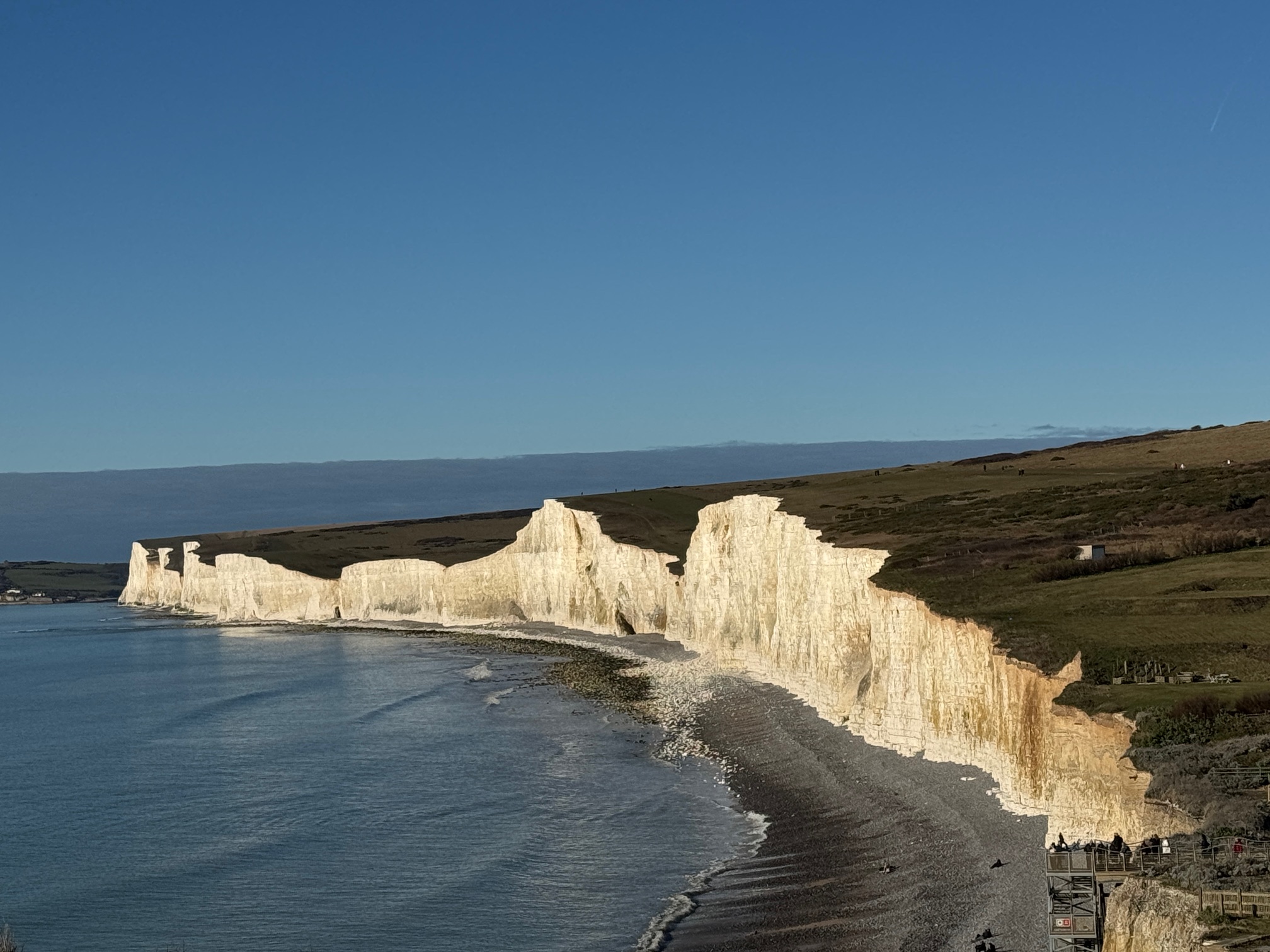
Not all of the Seven Sisters works with kids. Some of it really does.
Our oldest was three the first time we took her up to Belle Tout, and seven when she walked the full ridge. Our youngest currently insists rock-pooling at Birling Gap is the best afternoon out he has ever had, which is probably accurate. In between we've made every mistake the cliffs have to offer with small children — running out of snacks halfway between the second and third peak, underestimating the wind, trying to do the descent to Hope Gap with a toddler who'd just learned to refuse to walk.
This guide is the version of "Seven Sisters with kids" that we wish someone had given us. Clear about what works at what age, specific about which café tolerates a tantrum at 1pm on a Saturday, and unsparing about the bits people pretend are family-friendly when they're really not. The cliff edges are real cliffs. The ridge walk is a real walk. Underneath those caveats are some of the best family days out in southern England, and the bits that work, really work.
The page is laid out by age band. Pick the row that matches your youngest, and the rest will follow.
Find the row that matches your youngest.
Each card jumps to the right section.
Toddlers
Cuckmere beach walk, splash in the lagoon, ice cream. Don't attempt the ridge.
Early school
Rock-pooling at Birling Gap, short ridge sections, the lighthouse and back.
Big kids
The real walk. Birling Gap to Belle Tout to East Dean — lunch at the Tiger.
Tweens & teens
Full ridge, WWII radar station, smuggler caves, Saturday-evening photography.
Cuckmere Haven beach walk — the only route that works.
Under-fives and the clifftop ridge do not mix. The path is fenceless, the drop is seventy metres, and the wind on Haven Brow has knocked over more than one adult cyclist in our time of walking it. The good news is the alternative — the flat Cuckmere Haven beach walk from Exceat — is genuinely one of the best toddler walks in southern England.
Park at Exceat (the Seven Sisters Country Park car park; pay-and-display, £5 for the day, accepts cards). Walk south from the car park along the gravel meander path. The path is firm enough for any pushchair and flat the whole way. You'll pass the river, the Cuckmere meanders viewpoint, and reach the beach in about thirty minutes — slower if a two-year-old is in charge of the pace, which they should be.
What to do once you're there: the river mouth lagoon is the magic spot. Knee-high water, completely sheltered, sandy where the river runs over the shingle, and you can sit on the bank with a packed lunch while children paddle. The shingle beach itself is steep — fine for a paddle at the water's edge if an adult is with them, not somewhere a child should run unsupervised. The lagoon is the answer for under-fives.
The way back: if energy is gone, the same path back is fine — most toddlers will sleep in the pushchair from the meander viewpoint onwards. If they've got a second wind, the alternative is the chalk grassland path on the river's east bank — slightly rougher, no pushchair, but adds Friston Forest woodland to the day.
Lunch: picnic on the shingle bank, or the Cuckmere Inn at Exceat. The Inn has a beer garden, a kids menu, and is the friendliest pub for chaotic toddlers within five kilometres. Book if you want a table on a summer Saturday.
Rock-pooling at Birling Gap + the lighthouse — two reliable winners.
Five to seven is the age where the cliffs start to genuinely work. The kids can walk for two to three hours with snack breaks; they can be trusted near a cliff edge if you brief them clearly; they're interested in the things that actually live up there and at the bottom of the steps. Two activities cover the day cleanly: rock-pooling at Birling Gap, then the short ridge walk to Belle Tout lighthouse.
Rock-pooling first. Birling Gap National Trust beach is accessed by a metal staircase from the cliff-top car park (children must be supervised on the staircase — open metal, decent drop). At low tide, the chalk platform extends about fifty metres out and is a working tide pool ecosystem: sea anemones, hermit crabs, prawns, occasional small lobsters under the rocks. Critical: only go on a falling or low tide. The platform is cut off completely at high tide. Check tide times before you go; aim to arrive an hour before low tide and leave an hour after.
The National Trust shop at the top sells a £4 rock-pooling kit (net, bucket, simple species ID card) which is exactly the right balance of cheap and useful. The kit is the difference between half an hour of mild interest and two hours of focused absorption.
Then the lighthouse. From the Birling Gap café, the cliff-top path runs west to the Belle Tout Lighthouse — one kilometre exactly, gentle slope up. The lighthouse is a working B&B so you can't go in, but the kids will stop for photos, you can sit on the grass with biscuits, and the walk back is downhill. Total round trip from the car park: about ninety minutes including stops, which fits perfectly between rock-pooling and a meltdown.
If the tide is wrong: swap the order. Lighthouse walk first while the tide drops, then rock-pool. Or do the short Cuckmere Haven beach walk and come back to Birling Gap on a different day.
Birling Gap to East Dean — the real walk.
Eight is the age the proper walks open up. Most children who walk regularly can manage the full Birling Gap to Belle Tout to East Dean loop — five kilometres, two and a half hours moving time, three with lunch. It's enough of a hike that they finish proud of having done it, and short enough that the legs work in the afternoon.
The route: start at the Birling Gap car park (free for National Trust members, £8 for non-members; arrive before 10am on summer weekends or you won't get in). Walk west along the cliff-top path to Belle Tout Lighthouse (1km, twenty minutes). Continue past the lighthouse and turn inland at the marker post, following the South Downs Way down through the chalk grassland to East Dean village (2km, forty minutes). Lunch at the Tiger Inn (book if it's a weekend). Then walk the inland path back to Birling Gap via the Beacon Hill ridge (2km, forty minutes) — slightly steeper but the kids will be re-energised after lunch.
What makes this work for the age: the loop has built-in incentives. Twenty minutes of walking earns the lighthouse photo. Forty more earns lunch. Forty more earns the car. The variety — clifftop, chalk grassland, village, woodland-ish — keeps interest where a straight ridge walk would feel monotonous. And the cliff edges are clearly visible for the whole first kilometre, which is the dose of "real cliffs" children of this age have been waiting for.
The brief at the top: before you start, sit with them on the bench by the café and have the conversation. The path doesn't have a fence. The cliff edge is exactly where it looks. Stay on the inland side of the path; if there's no path on the inland side, hold a hand. We've never had an issue with an eight-plus child who got this conversation properly. We've heard of multiple near-misses with children who didn't.
The full ridge + the things they don't tell you about — a properly memorable day.
The teenage version of the Seven Sisters works if the parents take it seriously. The full Exceat to Eastbourne walk is fourteen kilometres, takes five to seven hours, includes seven proper climbs and one significant descent at Beachy Head, and is the same walk we'd hand to a fit adult. Done well, it's the kind of day a fifteen-year-old still talks about at university. Done badly, it's the day they decided family walks are over.
The things to brief them on:
The smuggler caves at Birling Gap. Below the cliffs at low tide, two genuine smuggler caves run back into the chalk. The smugglers ran French brandy and tobacco through these in the late 1700s; the customs records of seizures and shootings around Birling Gap and Beachy Head are publicly viewable in the East Sussex archives. Take them inside (only at low tide, never alone, head torch helpful). This is the thing that flips the "boring family walk" framing.
The Beachy Head radar station. The hilltop above Beachy Head Lighthouse has the foundations of a Second World War RDF (radar) station — one of the original Chain Home Low installations that tracked German aircraft and shipping across the Channel from 1940. The concrete bases are still there. Operational radar fragments are in the small Beachy Head museum (which is not always open; check before you build it into the day).
The geology. The cliffs are pure Cretaceous chalk — exclusively the skeletons of marine plankton that died and fell to the seabed between sixty-six and a hundred million years ago. You're standing on a hundred million years of microscopic dead organisms. Show them the embedded fossil sea-urchins at the cliff base near Birling Gap. This is a different kind of cool than they expected.
The route: bus 12X from Eastbourne to Exceat (35 minutes, runs hourly). Walk Exceat → Cuckmere Haven → up the first peak (Haven Brow, the highest) → ridge to Birling Gap (lunch at the National Trust café, two hours in) → Belle Tout → Beachy Head Lighthouse viewpoint → descent to Eastbourne via Whitbread Hollow. Six and a half hours including breaks. Train back to London or wherever you're staying.
Saturday-evening photography: for a different teenage approach, do the walk in reverse on a clear Saturday afternoon, arriving at Cuckmere meanders for the last forty minutes of golden light. The photographs they'll take with a phone are genuinely good. The walk back to the Exceat car park in dusk is part of the trip.
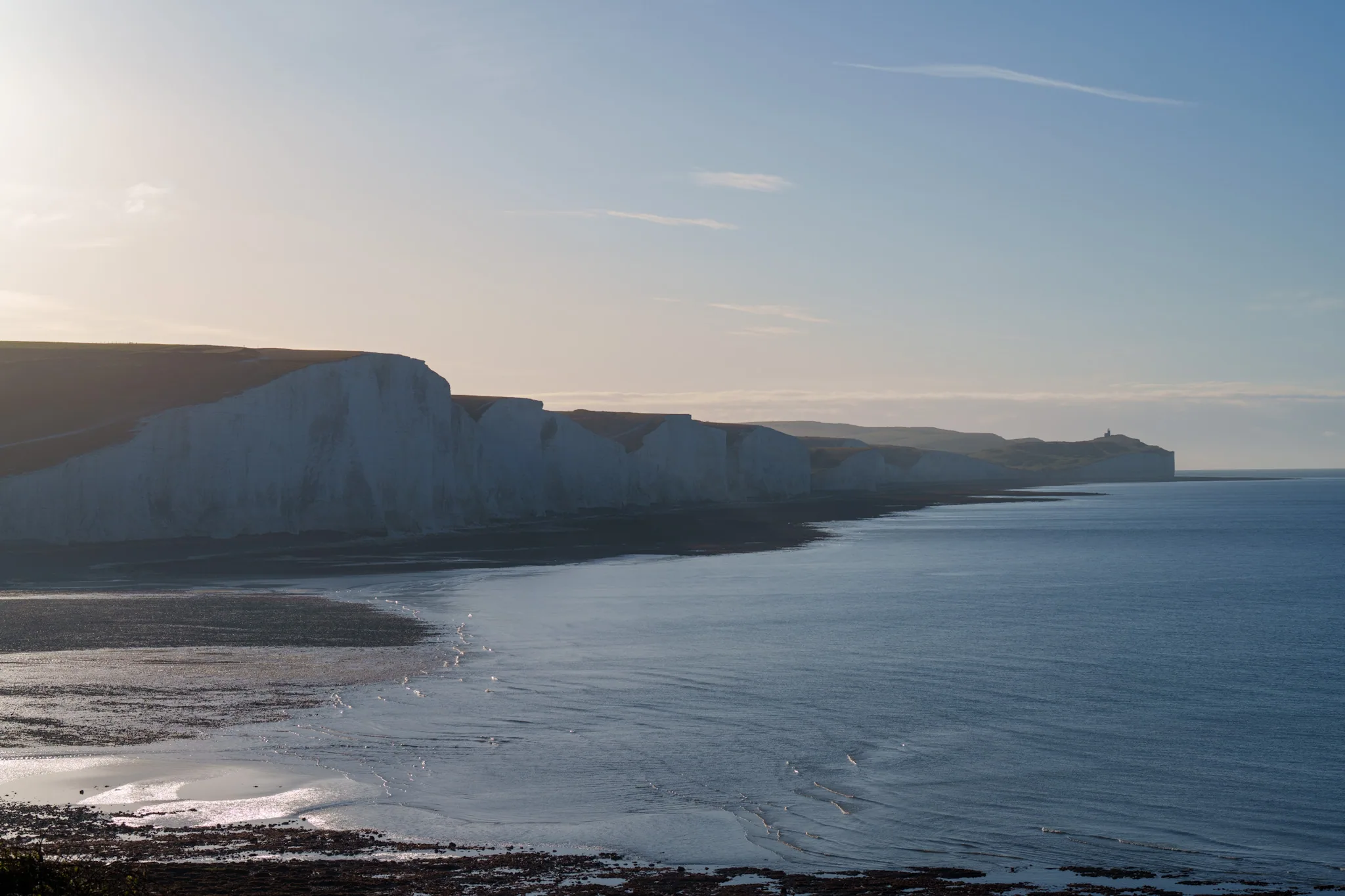
"He's eleven and he hates being called a kid. He spent fifteen minutes in the smuggler cave at Birling Gap and on the train back he told his cousins he'd been somewhere properly cool. The radar station did it for me."— Anna P., Lewisham · half-term February visit
Family-friendly tours worth booking.
Most adult-oriented walks have a minimum age of eight or ten. The handful that genuinely work with younger children — rock-pooling sessions, gentle family wildlife days, beach foraging — are listed below. Live availability and verified family reviews.
We earn a small commission on bookings made through this widget at no extra cost to you. Affiliate disclosure.
The food map. No surprises at lunchtime.
Twelve years of walking these cliffs with children of various ages and energy levels teaches you exactly which café to head to when. The truth about every option within five kilometres of the cliffs:
National Trust Café, Birling Gap
The pragmatic choice. Proper kids menu, high chairs, indoor and outdoor seating, fast service even at 1pm on a Saturday. Food is fine rather than memorable — the value is the friction-free family logistics. Queue gets long 12–2pm on summer weekends; arrive before 12 or after 2.
Cuckmere Inn, Exceat
The right pub if the kids need to run after lunch. Substantial kids menu, the beer garden is large and flat with views over the meander, dogs welcome. Book a table at the weekend; walk-ins are sometimes lucky on weekdays.
The Tiger Inn, East Dean
The best food within five kilometres of the cliffs, and a working coaching inn from 1722. Family-friendly until 9pm but the menu and atmosphere lean adult. Right for big kids who'll appreciate the pie and the pub history; less ideal for under-fives on a hungry afternoon.
Mill Café, Seaford
If you're staying in Seaford or arriving by train, the Mill is the answer for breakfast or a proper sandwich-and-coffee lunch. Under-tens eat well for £5. The Saturday morning crowd is half local dog-walkers, half visiting families — both groups tolerate the noise gracefully.
Beachy Head café
The café at the lighthouse car park is consistently underwhelming and over-priced — the kids menu is fish fingers and chips, the queue at lunch is fifteen minutes, the seating is exposed. Worth knowing about for an emergency, not worth planning around. Walk an extra kilometre to Birling Gap instead.
Seafront vans, Birling Gap car park
One or two ice-cream vans operate from the Birling Gap car park between Easter and the October half-term. Locally-made flavours, £3 a scoop. The Cuckmere Haven shingle beach also has a seasonal van in July and August. Both are the right answer when the kids have just walked four kilometres and need a non-meal win.
The packing list — slightly more than you think.
Twelve years of cliff-walking with children at different ages teaches you the brutal truth that the right number of snacks is roughly double what an adult eats. The list below covers under-eights; older kids and teens need less of the food, more of the weatherproof gear.
Essential gear
- Water — 750ml per child for half-day walks
- Snacks — twice what feels reasonable
- Waterproof jacket — even on sunny days, cliff wind is colder
- Proper shoes — trainers slip on wet chalk
- Sunscreen — exposed ridge, no shade for hours
- Hat — sun-hat or beanie depending on month
Useful extras
- Small first-aid kit — plasters, antiseptic wipes, micro-pore tape
- Tissues / wipes — chalk dust gets everywhere
- Tide-times printout — paper backup if signal drops
- Binoculars — even cheap ones transform a wildlife walk
- Small backpack per child — they carry their own jacket
- Rock-pooling net — £4 at the NT shop, or bring your own
Under-5s specifically
- Back-carrier — more useful than pushchair almost everywhere
- Spare socks & trousers — Cuckmere lagoon paddling is wet
- Comfort snack — the meltdown insurance policy
- Reins or wrist-strap — exposed cliff paths, gusty winds
- Travel potty — facilities are a 15min walk apart
- Patience — non-negotiable, not in the shop
Cliff safety with children — read this even if you're confident.
The cliff edges are not fenced. The South Downs Way crosses the entire 14km ridge from Seaford to Beachy Head, and on that entire path there is no barrier between the walking surface and a 70-metre drop. The path generally stays 10–20 metres inland, but several viewpoint spurs run right to the edge. Children who haven't been told otherwise will run there.
The chalk crumbles. Cliff falls happen on average every few weeks somewhere along the reserve, and you cannot see from the top which sections are most active. Stay at least five metres from any edge. Photographs taken from "the brink" have killed seven visitors in the last decade — there is no shot here worth that.
Tide-cut-off at Birling Gap and Cuckmere Haven beaches is real. The lower beaches at both locations are accessible at low tide and inaccessible at high tide. Being caught between the incoming tide and the cliff is genuinely life-threatening, especially with small children. Allow two hours minimum before the tide turns to return; check tide times before descending. Read our full safety guide before any beach visit with children.
Eastbourne usually wins — here's why.
For families, Eastbourne is the most practical base. The seafront has the widest selection of family rooms (Travelodge, Premier Inn and the mid-range hotels all do interconnecting or quad rooms — most B&Bs don't), the seafront promenade is a flat, traffic-free three kilometres that absorbs children needing to burn off energy, the Victorian pier still has a working arcade and a proper café, and the bus and car routes to Birling Gap are quick. Seaford is a strong second if you're car-free and want the cliffs even closer. Brighton works for older kids who'd appreciate the city but adds 35–40 minutes each way to the cliff days.
For a full neighbourhood-by-neighbourhood comparison see our where to stay guide. Live availability filtered to Eastbourne family-friendly listings below.
We earn a small commission on bookings made through this widget at no extra cost to you. Affiliate disclosure.
Questions parents always ask.
What age is right for the full ridge walk?
Is the Seven Sisters pushchair-friendly?
Where can children paddle or swim?
Are there cafés with kids menus and high chairs?
What if the weather changes?
Are dogs welcome alongside kids?
Three more family-relevant guides.
Everything else worth reading before a family day at the cliffs.