Seven Sisters
Dog Safety at Seven Sisters
Dogs are welcome. Cliff edges and excited dogs are not a safe combination. Here is exactly what the rules are and why.
Dogs are welcome. Cliff edges and excited dogs are not a safe combination. Here is exactly what the rules are and why.
Dogs are welcome at Seven Sisters year-round and it is a genuinely excellent walk for them. The specific risk is the cliff edge — an excited dog near it is a documented hazard. Here is exactly what the rules are and why.
Quick Answer
Dogs are allowed at Seven Sisters year-round on most paths and beaches. Dogs must be on short leads near the cliff edge and in areas with livestock. There is no water on the ridge — bring your own. Birling Gap beach is dog-friendly year-round. Emergency: 999 → Coastguard for any cliff incident involving a dog.
Any cliff emergency: 999 → Coastguard. Nearest A&E: Eastbourne DGH, Kings Drive, BN21 2UD.
Quick Answer — Dogs at Seven Sisters
Dogs are welcome at Seven Sisters year-round and can access Birling Gap beach in all seasons. On the cliff-top ridge, dogs must be on a short lead near the cliff edge — flexi-leads are not adequate as a dog can reach the edge before you can stop them. Dogs must also be on leads in areas with grazing livestock (National Trust land, typically May to September). There is no water on the ridge — carry your own for your dog. The beach at Birling Gap is dog-friendly year-round.
Yes. Seven Sisters is one of the most dog-friendly walking destinations on the East Sussex coast and dogs are permitted year-round on most paths and beaches. There is no general ban or seasonal exclusion from the main cliff-top path or Birling Gap beach. The rules that do apply are specific to two situations: the cliff edge and grazing livestock areas.
Hundreds of dogs walk the Seven Sisters ridge on busy weekends. It is a well-established dog walk and the paths are familiar terrain to most local dog owners. For visiting dogs and owners, knowing the specific requirements avoids the situations where dogs and cliffs become a problem.
Dogs must be on a short lead on all sections where the cliff edge is visible nearby or the path runs close to the drop. This is not a formal legal requirement in the same way livestock restrictions are, but it is the unambiguous safety requirement and the one the National Trust Birling Gap team consistently reinforces.
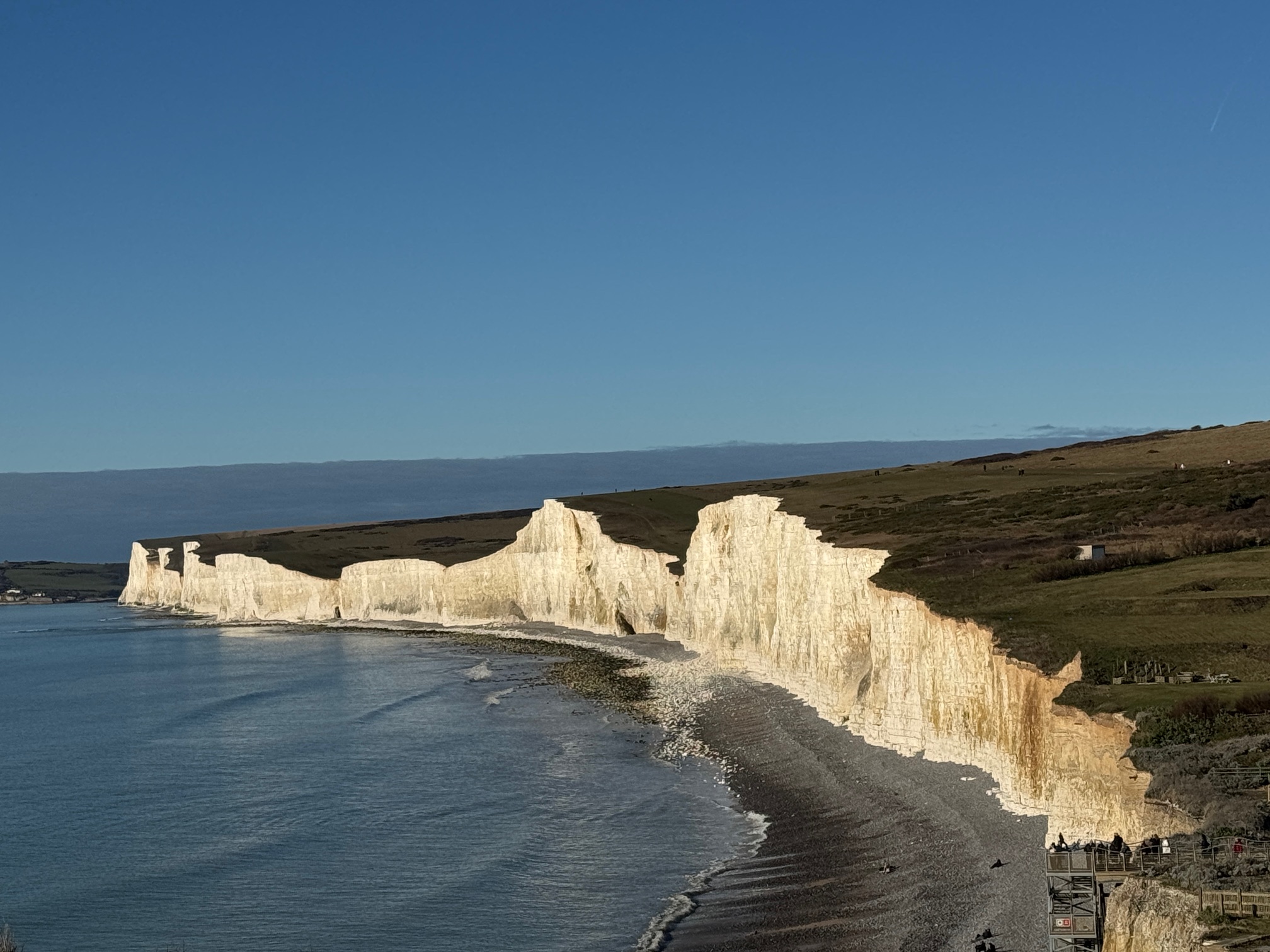
The reason is simple and specific. An excited dog that has spotted a seagull, rabbit, another dog, or anything else interesting and pulls toward the cliff top is not a dog the owner can reliably stop at the edge. The chalk cliff erodes and collapses without warning — there are no ropes, barriers or fences along most of the cliff path. A dog that runs to the edge and goes over causes a rescue operation and, in some cases, a second casualty when the owner tries to follow.
Flexi-leads near the cliff edge are not adequate. A flexi-lead at full extension gives a dog 5–8 metres of range in the direction of the cliff. The 5-metre safety rule applies to dogs as much as it applies to people — keep them within arm's reach on cliff sections, on a short lead.
On the open downland sections well back from the edge, dogs with reliable recall can go off-lead. The critical question to ask yourself honestly: if your dog spots a seagull 20 metres from the cliff edge, will it reliably come back when called? If there is any doubt, use a short lead on cliff-adjacent sections.
Livestock including sheep and cattle graze on parts of the Seven Sisters chalk downland and in the Cuckmere valley, particularly in spring and summer. When livestock are present, dogs must be on leads. This is both a legal requirement under the Animals Act 1971 (which makes dog owners liable for livestock injuries caused by their dog) and a basic consideration for the animals.
Signs at key access points indicate where livestock are present. On the main cliff-top path, livestock are less common but do appear periodically. In the Cuckmere valley floor, grazing livestock are present most of the year. If your dog has any history of chasing animals, keep them on lead throughout the valley sections.
If livestock panic and charge because of a dog, release the lead and let the dog run — do not try to hold on. Moving between a panicking cow and a dog is significantly more dangerous than letting the dog run.
Birling Gap beach is dog-friendly year-round. There are no seasonal dog restrictions at Birling Gap beach, making it one of the most reliably accessible beaches for dogs in East Sussex. The chalk shingle beach is good for dogs, the water is accessible for swimming, and the beach is busy enough that dog company is rarely absent.
The tide rule applies to dogs the same as to everyone: the beach disappears at high tide. Check tide times before going down the steps. The safe access window is two hours before to two hours after low tide. A dog on a flooding beach is a dog-and-owner rescue, which is not a straightforward operation. Check the tide before you go down.
Cuckmere Haven beach also generally permits dogs. Seasonal signage applies on some sections, particularly in nesting bird seasons in spring. Check National Trust signage at the access points.
The Seven Sisters ridge has no water sources between Birling Gap and Exceat — the entire 6km is open downland. Carry your dog's water. On a warm day doing the full ridge walk, a medium-sized dog needs at least 500ml, more for a larger breed or in high summer temperatures. The chalk reflects UV, the breeze masks how warm it actually is, and dogs do not regulate body temperature as efficiently as people.
Signs of overheating in dogs on the ridge: excessive panting, slow pace, reluctance to continue, drooling. If you see these, stop, give water, and find the nearest exit point to descend to the valley, which is significantly cooler. Do not push on. Heatstroke in dogs is an emergency — call 999 if the dog is unresponsive or collapsing.
For the cliff edge rules that apply to all visitors, see the cliff edge safety guide. For tide times and beach access, see the tide danger guide. For a comprehensive dog walking routes and tips guide, see our dog walking guide. For the full safety overview, see the safety hub.
Livestock, cliff edges and total distance vary a lot between the four routes. Compare them before you decide where to take your dog.
£4.99 · 24-page PDF · Instant download
The complete 24-page companion built from first-hand walks — every cliff, all four graded routes, tide windows and a parking strategy. Designed to work offline, right on the cliff top.
Just want the basics? Download the free 2-page walk guide
Stay up to date with seasonal guides, crowd forecasts, and local tips — direct to your inbox.
No spam. Only coastal inspiration and timing tips — unsubscribe any time.