Seven Sisters
Winter Walking at Seven Sisters
Beautiful on the right days. More demanding in every way. Here is how to find the good windows and use them safely.
Beautiful on the right days. More demanding in every way. Here is how to find the good windows and use them safely.
Winter at Seven Sisters is genuinely beautiful on the right days — low sun on white chalk, empty paths, extraordinary photography conditions. It is also more demanding than a summer visit in every relevant way. Here is how to do it properly.
Quick Answer
Seven Sisters is walkable in winter on settled days between weather systems. Check CoastMetric the morning of your visit, start by 10am at the latest (daylight is limited to 7.5–8 hours), wear waterproofs and walking boots, and stay further back from the cliff edge than usual — chalk is most structurally vulnerable after rain and frost. Emergency: 999 → Coastguard.
Any emergency: 999 → Coastguard (cliff/beach). Nearest A&E: Eastbourne DGH, Kings Drive, BN21 2UD — 20 min from Birling Gap.
Quick Answer — Winter Walking at Seven Sisters
Seven Sisters is walkable in winter but requires specific preparation. Chalk paths become near-frictionless when wet or frosted — trail shoes are inadequate; walking boots with mud grip are required. January and February bring the highest storm risk, with sustained gusts above 60 mph possible. Daylight is limited (7.5 hours in December) so start by 10am. The cliff edge is more dangerous in winter because freeze-thaw cycles actively weaken the chalk. Check wind forecasts before going, not temperature forecasts.
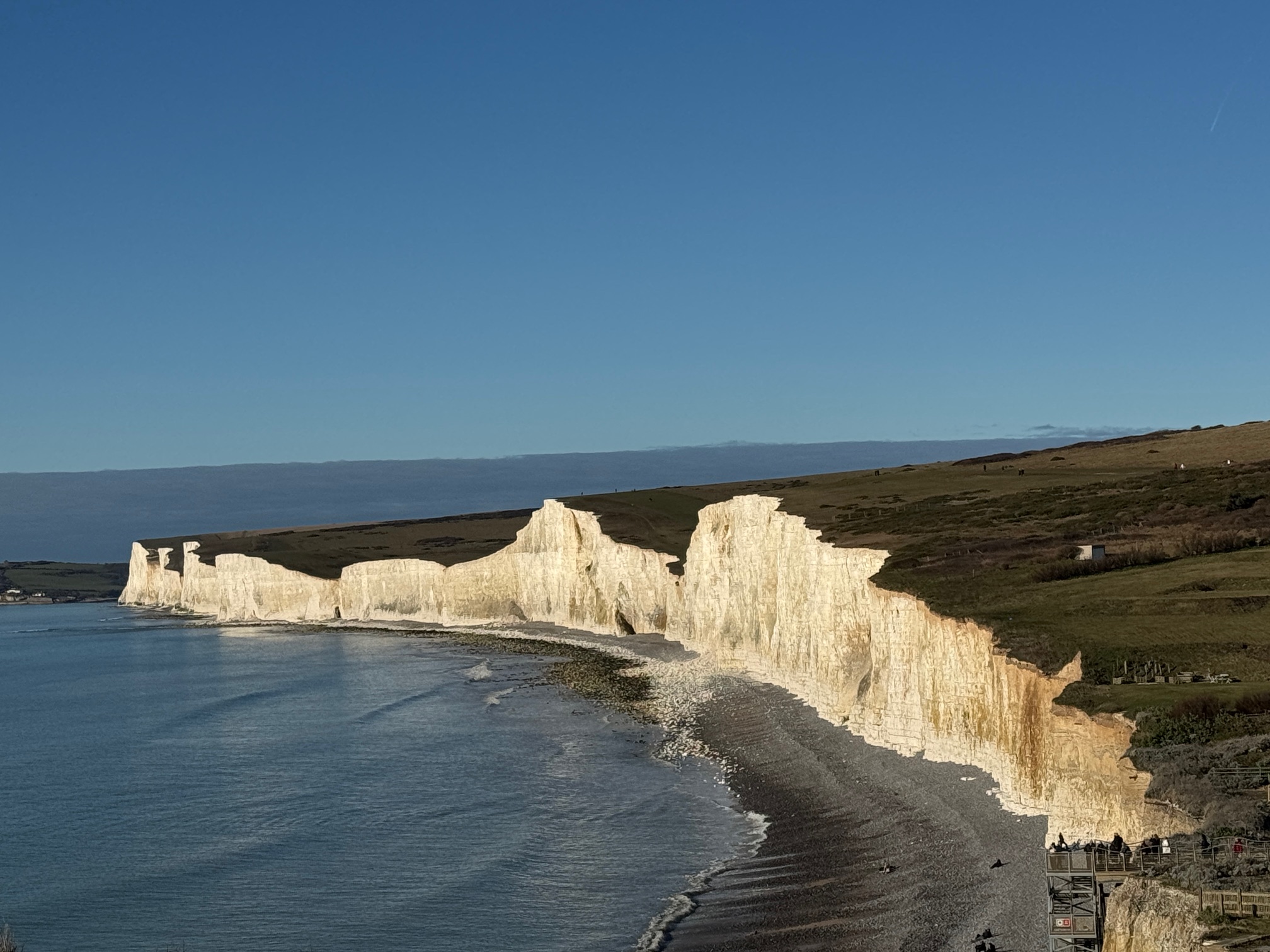
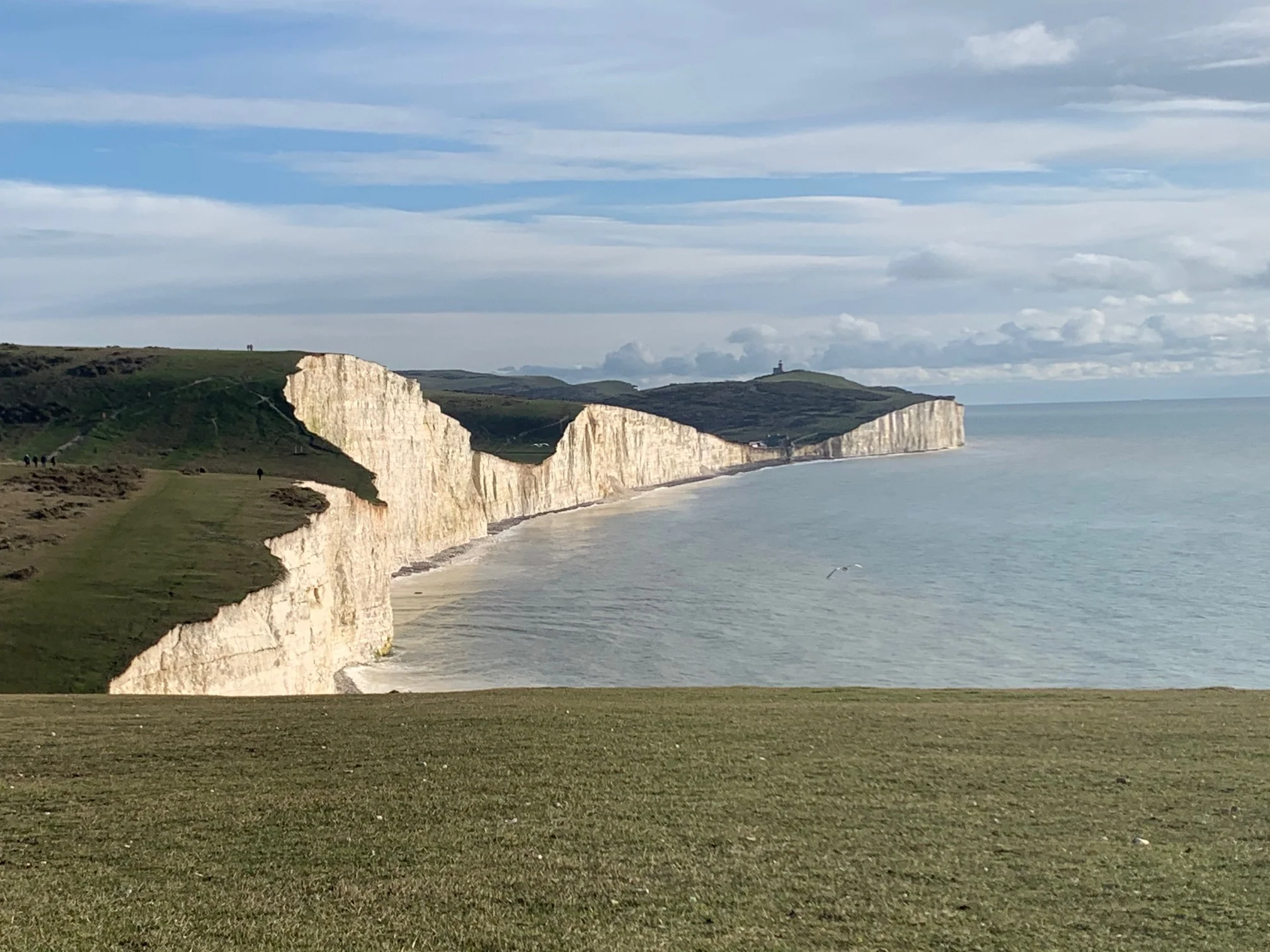
The Seven Sisters in winter is not a compromise visit. On a settled, clear winter day, the low sun hits the chalk face at an angle that summer never achieves. The light is extraordinary. The paths are empty. The ridge feels enormous without 2,000 other visitors on it. The photography conditions — low light, long shadows, cold colours — are the best of the year for landscape photographers.
The caveat is that winter visits require knowing what you are walking into in a way that summer does not. In July, the main decision is whether to bring sun cream. In January, the decisions are whether to go at all that day, which route to take, how early to start, what to wear, and what to do if conditions change faster than expected. All of those decisions are manageable with the right information.
January and February are the highest-risk months for walking Seven Sisters. Atlantic low-pressure systems dominate the weather pattern, and this stretch of coast — fully exposed to the Channel with no topographic windbreak — receives the full force of westerly and southwesterly gales. Named storms in January and February regularly produce sustained winds of 40–50 mph on the exposed ridge, with gusts above 60 mph not unusual and above 70 mph in the strongest systems.
At 40 mph sustained wind, the exposed Seven Sisters ridge is at the limit of safe walking for most adults. At 60 mph gusts, it is not safe to be on the ridge regardless of experience. The physics are not about skill or fitness — a 60 mph gust on an exposed cliff top is an unpredictable physical force that can push or destabilise anyone.
Between storm systems, there are settled periods of high pressure that bring the best winter days — clear, cold, low wind, extraordinary light. The approach to winter walking at Seven Sisters is to identify these windows and use them, not to plan fixed visits and hope the weather cooperates.
Check CoastMetric the morning of your planned visit, not the night before. Winter weather at the coast changes faster than model forecasts capture. A forecast that shows moderate winds for tomorrow may look different by tomorrow morning when the actual pressure gradient has developed.
The single biggest practical hazard for winter walkers at Seven Sisters is not wind. It is traction on the chalk paths. The ridge descents — the slopes down into each dry valley between the sisters — are chalk. In summer that chalk is dusty and firm. After rain it becomes wet and extraordinarily slippery. After frost it is effectively ice.
These are not gentle slopes. The descents into the valleys are steep enough that slipping on the way down generates momentum quickly. A slip on wet chalk in smooth-soled shoes does not recover the way a slip on a hill path does. There is nothing to grab. The landing area at the bottom of some descents is the valley floor, which is fine. On others, the geometry is more serious.
Walking boots with mud-grip soles make a genuinely significant difference to winter chalk traction. Vibram or equivalent rubber compounds grip wet chalk. Smooth rubber trainer soles do not. This is not about ankle support — it is a surface traction issue. Fashion boots, canvas shoes, and trainers are not appropriate footwear for the Seven Sisters ridge after rain or in frosty conditions.
December at Seven Sisters means approximately 7.5 hours of usable daylight — sunrise around 8am, sunset around 3:45pm. A full ridge walk (Cuckmere to Birling Gap and back, or Seaford to Birling Gap) takes 3–4 hours. This leaves almost no margin for error in the timing if you start mid-morning.
The practical rule for winter ridge walks: start by 10am at the absolute latest. This gives you 5 hours before sunset, which accommodates a full ridge walk with a margin. Starting at 11am in December means your return leg may run into late afternoon light — and the chalk paths are more treacherous in poor light. Starting at noon is not appropriate for a full ridge walk in December or January.
For shorter walks in winter — Birling Gap to the first two peaks and back — the timing constraint is less acute, and a midday start is fine. The issue is the full ridge route, which cannot be shortened easily once you are past the midpoint.
The chalk cliff is structurally most vulnerable in winter. Freeze-thaw cycles — the primary mechanism of chalk weakening — are most active in autumn and winter when temperatures move above and below freezing. Heavy winter rainfall saturates the chalk, increasing pore pressure and reducing structural strength. The combination means a winter cliff edge carries a higher collapse risk than a summer one.
The 5-metre rule from the visible cliff edge is not optional in any season. In winter, treat it as a firm minimum and walk further from the edge where you can. After overnight frost or after heavy rain — particularly in the two hours after heavy rain begins to dry — the chalk directly at the edge is at its most compromised. This is not the time to stand close.
Seven Sisters is walkable in winter on settled days between weather systems, but winter visits require significantly more preparation than summer. The specific risks are: storm-force winds on the exposed ridge (gusts above 60 mph possible in January and February), chalk paths that become near-frictionless when wet or frosted, and daylight limited to 7.5–8 hours in December. Walk in the middle of the day, check CoastMetric the morning of your visit, and do not start a full ridge walk if the weather is unsettled.
Winter is dominated by Atlantic low-pressure systems bringing strong winds, rain, and occasional storm conditions. January and February are the highest-risk months — named storms regularly produce gusts above 60 mph on the exposed chalk ridge. Between storms, settled periods of clear, cold, still weather produce the best photography conditions of the year. The key is identifying these windows and using them rather than attempting to walk in storm conditions.
Yes, significantly. Polished chalk paths become extremely slippery in wet or frosty conditions — the surface approaches ice-like traction on the descents into the dry valleys between each sister. After rain, the chalk holds water and the surface is treacherous. After frost, the surface can be literally icy. Walking boots with mud-grip soles make a substantial difference. Smooth-soled shoes or fashion boots are not safe on wet chalk descents in winter.
Yes. The chalk cliff is most structurally vulnerable after heavy rainfall and during freeze-thaw periods — both common in winter. The freeze-thaw cycle is one of the primary mechanisms of chalk collapse and is most active in autumn and winter. Combined with wind gusts that can physically unbalance walkers, the 5-metre rule from the cliff edge is even more important in winter conditions.
December has approximately 7.5 hours of usable daylight — sunrise around 8am, sunset around 3:45pm. A full ridge walk takes 3–4 hours. For winter ridge walks, start by 10am at the absolute latest. Starting at noon in December is not appropriate for a full ridge walk — your return leg will run into darkness.
November is the most reliably accessible winter month — storm frequency has not yet reached January–February peak levels, there is still enough daylight for a full ridge walk starting at 10am, and the autumn crowds have gone. March is the other reliable shoulder-season month — storm risk drops significantly, daylight is extending, and wildflowers are beginning. January and February require the most care.
Waterproof walking boots with ankle support and mud-grip soles (not optional in winter), waterproof overtrousers and jacket (the ridge is fully exposed), an insulating mid-layer, hat and gloves (wind chill at 25 mph drops feels-like temperature by 8°C), and a head torch regardless of whether you plan to need it. Do not rely on being back before dark — be equipped for it.
Light snow on the ridge is extremely slippery — chalk paths with snow are as dangerous as ice on the descents. In icy conditions, the valley descents are not safely negotiable without walking crampons or microspikes. If overnight frost has occurred, start later than usual (post 11am) to allow temperatures to rise, or walk the valley paths instead of the cliff top ridge.
For the go/no-go wind and visibility thresholds year-round, see the weather and conditions guide. For the cliff edge collapse risk that is elevated in winter, see the cliff edge safety guide. For the full safety overview, see the safety hub.
The full ridge needs six to seven hours, which uses almost all the usable light a midwinter day gives you. Compare the four routes and their timings.
£4.99 · 24-page PDF · Instant download
The complete 24-page companion built from first-hand walks — every cliff, all four graded routes, tide windows and a parking strategy. Designed to work offline, right on the cliff top.
Just want the basics? Download the free 2-page walk guide
Stay up to date with seasonal guides, crowd forecasts, and local tips — direct to your inbox.
No spam. Only coastal inspiration and timing tips — unsubscribe any time.