Seven Sisters
Tide Safety
The beach disappears at high tide. Here is exactly when and what to do about it.
The beach disappears at high tide. Here is exactly when and what to do about it.
The beach disappears at high tide. People get stranded every year by not checking before they walk down the steps. Here is the access window, what happens when you miss it, and what to do.
Updated May 2026. Reflects direct observation of tidal conditions at Birling Gap and Cuckmere Haven across multiple seasons, including incidents observed from the cliff path above.
Stranded on beach: 999 → Coastguard. Stay high against the cliff base. Do not attempt to climb the cliff.
Quick Answer — Tides at Seven Sisters
The beach at Birling Gap and Cuckmere Haven disappears completely at high tide. Safe access is within two hours either side of low tide. The tidal range is 5–7 metres and the incoming tide can cover 10–20 metres of beach in under 30 minutes during the flood phase. Always check tide times before visiting the beach — search "Birling Gap tide times" for the day's low tide. If stranded, call 999 and ask for the Coastguard immediately.
2 hours before low tide → 2 hours after low tide
Outside this window the beach is narrowing or already inaccessible. Check your local tide time (search "Birling Gap tide times" or "Eastbourne tide times") before you visit. The tide shifts by approximately 50 minutes later each day.
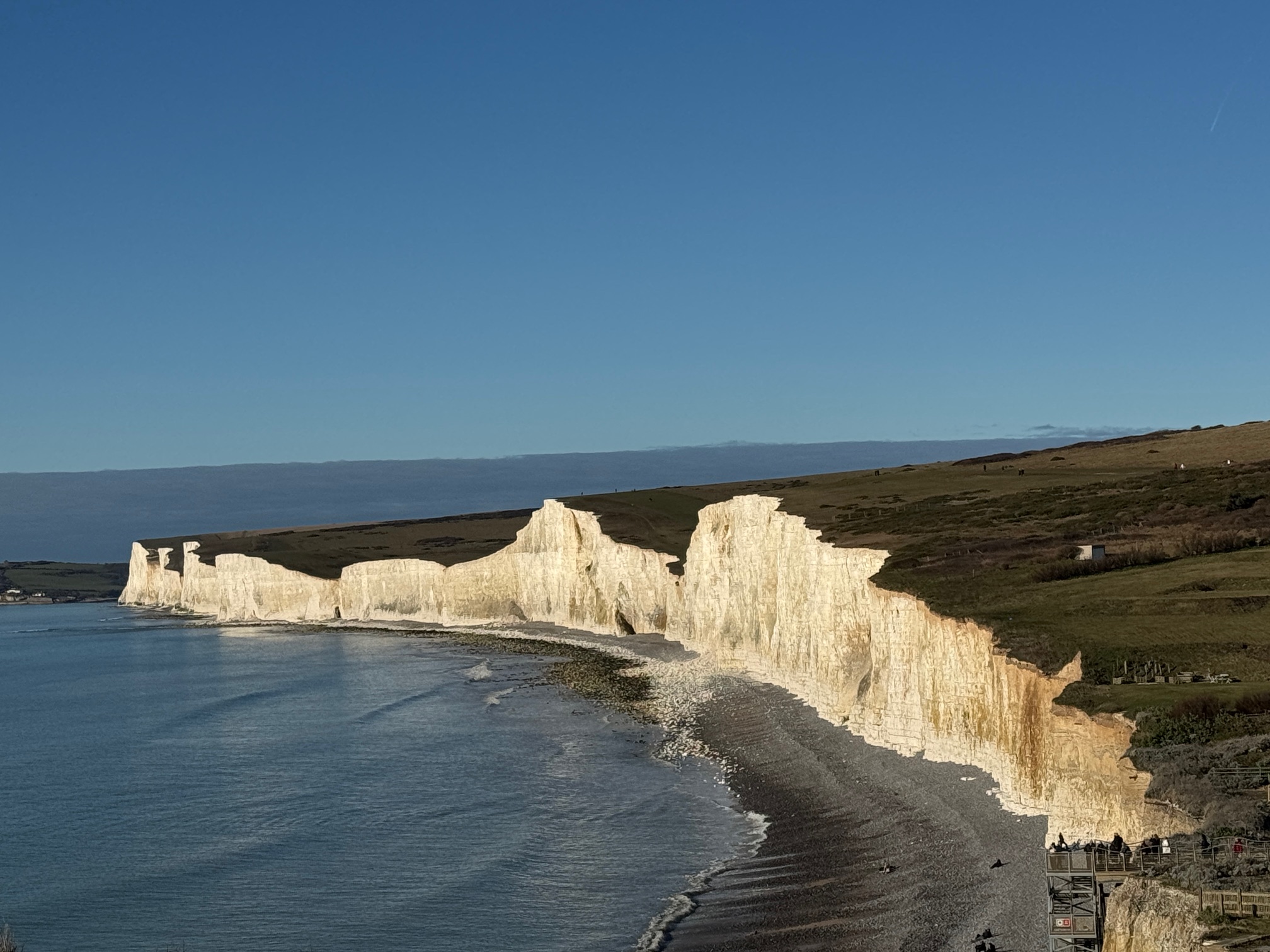
At high tide, there is no beach at Birling Gap or Cuckmere Haven. Not "a narrow strip of beach" — no beach at all. The sea reaches the base of the chalk cliff directly, and waves push against the rock face. There is nowhere to stand. Anyone who went down to the beach without checking tides and stayed too long is now standing against the cliff with the water at their feet.
This happens more than people think. Visitors walk down the steps at Birling Gap, spend an hour on the beach, and return to find the steps are the only dry route back up and the water is several metres up the base of the cliff on either side. If the steps are accessible, they can still leave. If the tide has come in past the steps — which happens on exceptionally high tides — they cannot.
Cuckmere Haven has a slightly different character. The beach there is backed by the river mouth and the valley, and the tidal exposure is slightly less extreme than Birling Gap. But the same principle applies: at high tide the beach disappears. The only safe route back inland from Cuckmere Haven is via the official valley footpaths — the west bank path, or the east bank reached by walking inland and crossing at Exceat Bridge, the A259 road bridge by the visitor centre. There is no crossing at the beach. Do not attempt to cross the Cuckmere river itself at any point. The river is tidal at this section, the current is unpredictable, and the riverbed is soft and unstable. Every year people wade toward it and every year it is the wrong decision.
The Sussex coast has a tidal range of 5 to 7 metres between low and high water. Over the roughly 6 hours between low and high tide, that water has to go somewhere — and during the middle two hours of the incoming tide (the flood phase), the sea is advancing fastest. In the fastest part of the cycle, 10–20 metres of beach can disappear in 30 minutes.
This is why "the tide wasn't coming in when we went down" is not reassuring. The middle of the flood phase looks deceptively calm at the edges and then suddenly the beach is half the width it was twenty minutes ago. If you are at Birling Gap and the water is noticeably closer to the cliff base than when you arrived, leave immediately. Do not wait to see how it develops. It develops quickly.
Call 999 and ask for the Coastguard. Do not wait until the water is around your ankles — call as soon as you realise you cannot safely leave the beach by the normal route. The Coastguard will ask your location and can reach you from the cliff path above, from the sea, or by helicopter. HM Coastguard Birling Gap is the local station and they know this beach.
While you wait: move to the highest point of the beach, against the cliff base. If the tide is still rising, climb up the beach as far as possible. Do not attempt to climb the chalk cliff. The chalk face is loose, crumbles under weight, and cliff rescues from people who attempted to climb out create additional casualties every season. Stay on the beach and let the Coastguard come to you.
Keep your phone dry. Put it in a pocket or bag above the waterline. An incoming tide at the base of a chalk cliff does not produce a calm, gently rising waterline — it produces waves that push up the cliff face and swell without warning. Even on days when the sea looks flat from the top, the cliff base zone has wave action. Keep everything important above head height if possible.
Check before you leave for the day, not when you arrive at the car park. Tides shift by approximately 50 minutes later each day, which means what was low tide at 10am yesterday is low tide at 10:50am today and 11:40am the day after. If you visited last week and the beach was accessible when you arrived, it may not be accessible at the same time this week.
The most useful tool for this stretch is the Eastbourne or Birling Gap tide prediction. Searching "Birling Gap tide times" on any device brings up accurate results from BBC Weather, Tide-Forecast.com, and the Met Office. The number you want is the low tide time — and you want to arrive within two hours either side of that time for the widest beach and the full safe window.
If you are at Birling Gap visitor centre, the National Trust team there can tell you the day's low tide time. The café staff know, because they watch the beach every day. Asking them takes 10 seconds.
Rock pooling at Birling Gap is one of the genuinely excellent things to do at Seven Sisters with children, and it is specifically a low-tide activity. The pools are only visible and accessible in the two hours around low tide. This is also the safe window to be on the beach with children, because the incoming tide period that follows is the dangerous one.
The rule we apply: set a departure alarm on your phone for 90 minutes after low tide. When it goes off, everyone goes back up the steps regardless of whether they have finished. The beach will narrow quickly in the hour after that alarm. Having the alarm removes the "just five more minutes" negotiation with children that can push you into the wrong part of the tidal cycle.
Two hours before low tide to two hours after low tide. Outside this window the beach is narrowing or inaccessible. At high tide there is no beach at all — the sea reaches the chalk cliff base directly. Check "Birling Gap tide times" on any device before leaving home, not when you arrive at the car park. The tide shifts approximately 50 minutes later each day.
Call 999 and ask for the Coastguard immediately — do not wait until the water is at your feet. Move to the highest point of the beach, against the cliff base. Do not attempt to climb the chalk cliff face. The Coastguard can reach you by sea, from the cliff path above, or by helicopter. HM Coastguard Birling Gap knows this beach and responds to these incidents regularly.
The tidal range on this stretch of coast is 5–7 metres. During the middle two hours of the flood phase (incoming tide), the sea can cover 10–20 metres of beach in under 30 minutes. The tide does not arrive at a steady rate — the middle of the flood is noticeably faster than the start. If the beach is visibly narrowing, it will narrow quickly. Leave immediately rather than waiting to see how it develops.
Swimming is possible at Birling Gap and Cuckmere Haven at low tide, but there are no lifeguards at either beach. Water temperature is 14–18°C in summer. Cold water shock is the primary risk for swimmers entering without acclimatisation. Only swim within the low tide window and never alone. Current below the chalk cliff face can be unpredictable, particularly near headlands.
Search "Birling Gap tide times" or "Eastbourne tide times" on any device before you leave. BBC Weather, Tide-Forecast.com, and the Met Office all provide accurate predictions. The key number is the low tide time — plan to arrive within two hours either side. The National Trust team at Birling Gap visitor centre can also tell you the day's low tide. Tides shift approximately 50 minutes later each day, so last week's timing is not reliable this week.
Yes — Cuckmere Haven beach also disappears at high tide. The safe access window is the same: two hours either side of low tide. The key difference at Cuckmere Haven is the exit route: leave via the official valley footpaths, not across or through the Cuckmere river. The river is tidal at this point and should never be waded. There is no crossing at the beach; the safe route inland is the valley footpath, crossing the river only at Exceat Bridge, the A259 road bridge by the visitor centre.
For the full tide times guide including photography timing and swimming safety, see our tide times guide. For rock pooling specifics including the best pools and what to look for, see our rock pooling guide. For the full safety overview, see the safety hub.
Walking on the shingle below the cliffs is what the tide restricts — the clifftop routes stay above it. Compare the four routes and see which ones keep you off the beach entirely.
Stay up to date with seasonal guides, crowd forecasts, and local tips — direct to your inbox.
No spam. Only coastal inspiration and timing tips — unsubscribe any time.