Seven Sisters
Hiking Preparation
What to wear, what to bring, and what the walk actually demands. The preparation that makes the difference.
What to wear, what to bring, and what the walk actually demands. The preparation that makes the difference.
What to wear, what to bring, what the walk actually demands, and the specific mistakes that turn a good day into a bad one. All of this is straightforward to avoid if you read it before you leave.
Quick Answer — What to Bring
Walking boots (mud-grip, ankle support), 1.5L water per person, mid-layer in the top of your bag, offline map downloaded before leaving, fully charged phone, sun cream in warm weather. Tell someone your route and return time. Emergency: 999 → Coastguard.
Any emergency on the walk: 999 → Coastguard (cliff/beach) or 999 → Ambulance (medical). Nearest A&E: Eastbourne DGH, BN21 2UD.
Quick Answer — Hiking Preparation for Seven Sisters
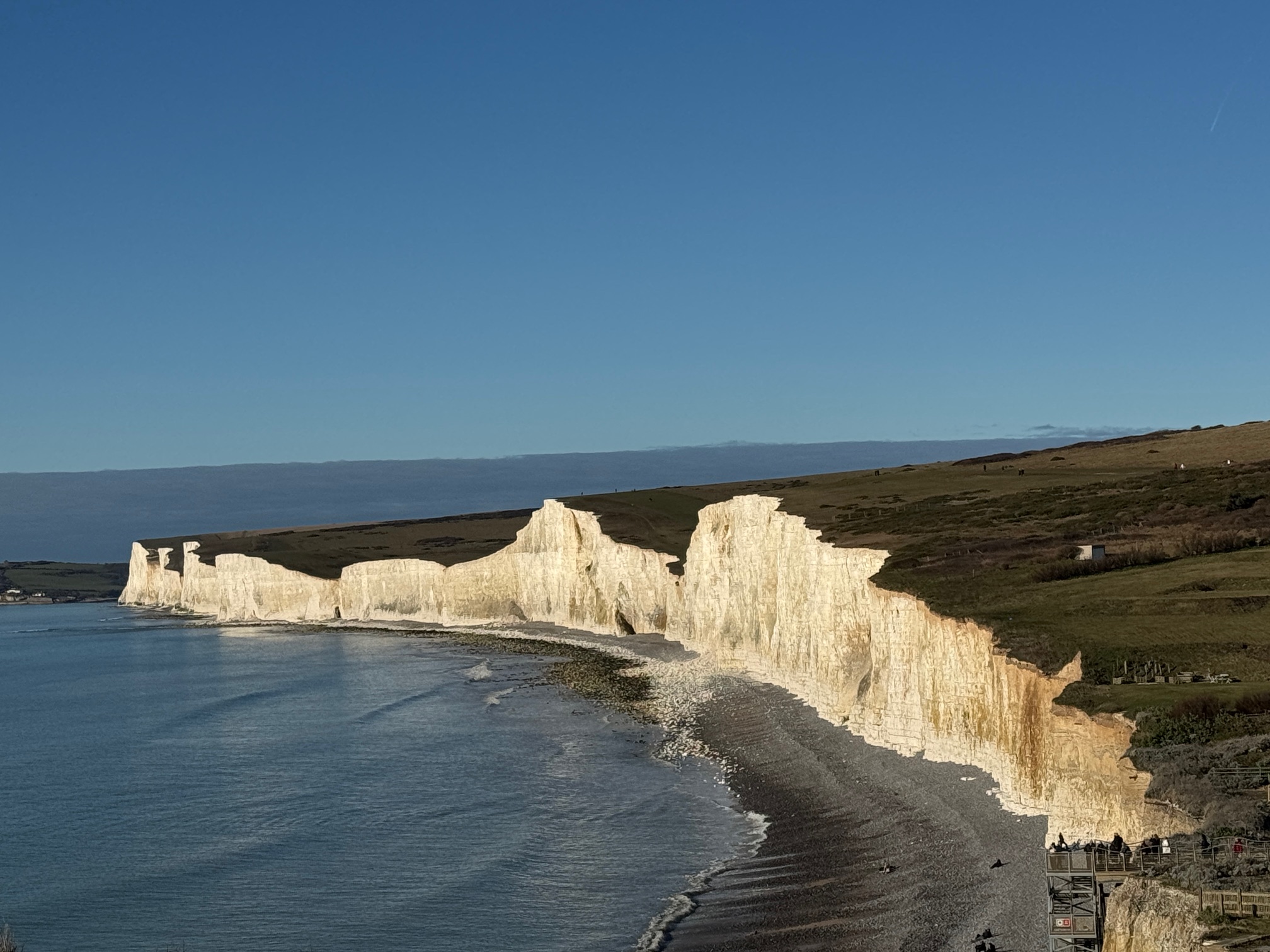
The full Seven Sisters ridge (Cuckmere Haven to Birling Gap, 6.5km) involves approximately 560m of combined ascent and descent across the seven cliff summits. It is moderate difficulty but requires proper footwear — walking boots with grip are essential as chalk becomes extremely slippery when wet. Carry at least 1.5L of water (no sources on ridge), layers for coastal wind, a fully-charged phone with an offline map downloaded, and a plan shared with someone who knows your expected return time. Trainers and flip-flops are the most common footwear mistake.
Every year, people attempt the Seven Sisters ridge walk in canvas shoes, fashion boots, and smooth-soled trainers. On a dry summer day, this is manageable. In any other conditions, it is a traction problem that ranges from uncomfortable to dangerous.
The specific hazard is the chalk descent. Between each of the seven sisters is a dry valley — the path drops steeply down one side and climbs up the other. On these descents, the chalk surface becomes extremely slippery in wet conditions. A smooth rubber sole on wet chalk generates almost no friction. The path is worn by millions of feet and the surface is polished. In wet conditions, walking in smooth-soled shoes on the valley descents is comparable to walking in socks on a wet bathroom floor.
Walking boots with ankle support and mud-grip rubber soles — Vibram compound or equivalent — change the experience fundamentally. The difference in grip between walking boots and trainers on wet chalk is not subtle. It is the difference between feeling secure and feeling like you might fall at any step.
Ankle support matters separately. The ridge path is uneven, and a rolled ankle on a steep chalk descent is the most common injury on this walk. Good ankle support does not prevent all rolls, but it significantly reduces the severity of those that do occur. A twisted ankle that is a minor inconvenience in stiff walking boots can be a significant injury in lightweight trainers.
The Seven Sisters ridge is fully exposed to the Channel. There is no windbreak between you and France for most of the walk. Weather here is faster-changing than inland, and the temperature difference between the car park and the ridge can be 6–8°C once wind chill is factored in.
Base layer: Merino wool or synthetic (not cotton). Cotton holds moisture and causes chilling when it gets wet with sweat or rain.
Mid-layer: A fleece or thin down jacket that fits in a small bag and can be put on in 30 seconds. This is the layer that matters when sea fog arrives — you need to be able to add it immediately without stopping to unpack your rucksack. Keep it accessible.
Outer layer: A windproof shell at minimum; waterproof from October to May. The ridge is exposed and rain is frequent outside summer. A waterproof that lives at the bottom of a bag is not useful when a rain squall arrives in the middle of the walk.
Sun protection: SPF 50 sun cream, re-applied every two hours in summer. Hat and UV-protective sunglasses. The chalk reflects UV upward as well as receiving it from the sky — effective UV exposure on the ridge is higher than a UV index reading suggests, and the sea breeze masks how much sun you are getting.
The Seven Sisters ridge has zero shade and zero water sources for the full 6.5km between Birling Gap and Exceat. The standard recommendation is 1.5L per person for the full ridge walk in warm weather. In summer heat, increase this to 2L.
The Birling Gap café is the only refreshment facility on the walk itself. On busy summer weekends it sells out of bottled water by early afternoon. Do not plan to restock at Birling Gap and then continue east — you may have no water available. Start with everything you need for the full return trip.
Children dehydrate faster than adults. 2L per child on a hot summer day for the full ridge walk is not excessive.
| Item | Short walk (<4km) | Full ridge (6.5km+) |
|---|---|---|
| Walking boots (mud-grip) | Essential | Essential |
| Water | 1L per person | 1.5–2L per person |
| Windproof mid-layer | Essential | Essential |
| Waterproof jacket | Recommended (Oct–May) | Essential (Oct–May) |
| Offline map downloaded | Recommended | Essential |
| SPF 50 sun cream | Summer | Summer Essential |
| Food / snacks | Optional | Recommended |
| First aid kit (basic) | Optional | Recommended |
| Head torch | Optional | Winter Essential |
The right boots and clothing are the difference between a great walk and a miserable one. These are what we genuinely recommend for chalk clifftop paths.
As an Amazon Associate we earn from qualifying purchases — at no extra cost to you. Affiliate info.
Seven Sisters is not a flat walk. The ridge involves repeated ascents and descents of up to 70 metres on chalk slopes. The full Cuckmere to Birling Gap and back route (approximately 13km) involves around 560 metres of total ascent — comparable to climbing a 560-metre hill, spread across multiple smaller climbs rather than one sustained ascent.
This is a moderate walk, not a strenuous one. It does not require technical walking skills, mountain experience, or specialist fitness. It does require: the ability to sustain 3–4 hours of walking including sustained uphill sections, stable enough knees and ankles to handle repeated descents on uneven chalk, and awareness of how you are feeling as you go. The path cannot be shortened easily once you are past the midpoint — the main exits are at Birling Gap (east) and Exceat (west). Plan a route you can complete, not the longest one that seems doable in theory.
Shorter route option: Birling Gap to the first two peaks and back is approximately 3–4km with around 150 metres of total ascent. This is appropriate for anyone who is uncertain about the full route, walking with children under 10, or doing their first visit. It gives a genuine experience of the ridge without committing to the full 6.5km.
1. Smooth-soled footwear. The most common reason people have a bad time on this walk. Walking boots make it a different experience.
2. Not carrying a mid-layer. Sea fog drops temperatures 6°C in under two minutes. The layer needs to be in the top of your bag, not buried at the bottom.
3. Relying on a phone map without offline data. Mobile signal is patchy on the ridge. Download your route before you leave. OS Maps allows offline downloads and works without signal.
4. Not checking tide times before going to the beach. The beach at Birling Gap and Cuckmere Haven disappears at high tide. Search "Birling Gap tide times" before you leave home, not in the car park.
5. Approaching the cliff edge for photographs. The cliff erodes and collapses without warning. The 5-metre rule applies to everyone. The best photographs are taken from further back, not from the edge.
No shops or water taps on the ridge. These are the essentials that should be in your daypack before you start.
As an Amazon Associate we earn from qualifying purchases — at no extra cost to you. Affiliate info.
For tide times and beach access, see the tide danger guide. For weather conditions and go/no-go thresholds, see the weather guide. For winter-specific preparation, see the winter walking guide. For routes and distances, see our walking routes. For the full safety overview, see the safety hub.
£4.99 · 24-page PDF · Instant download
The complete 24-page companion built from first-hand walks — every cliff, all four graded routes, tide windows and a parking strategy. Designed to work offline, right on the cliff top.
Just want the basics? Download the free 2-page walk guide
Stay up to date with seasonal guides, crowd forecasts, and local tips — direct to your inbox.
No spam. Only coastal inspiration and timing tips — unsubscribe any time.