Seven Sisters
Cliff Edge Safety
The chalk erodes faster than you think. Here is what that means for where you stand.
The chalk erodes faster than you think. Here is what that means for where you stand.
The chalk erodes faster than almost anywhere in England. Here is exactly how close is too close, and why the edge is not where you think it is.
Updated May 2026. Reflects conditions observed across all seasons including post-storm visits and winter frost periods on the Seven Sisters ridge.
Seven Sisters Cliff Edge — Risk Summary
| Factor | Risk Level |
|---|---|
| Standing at cliff edge | High |
| Cliff edge after heavy rain | Very High |
| Photography near edge | High |
| Strong wind on exposed peaks | Moderate–High |
| Children near cliff edge | High |
| Dogs off lead near cliff edge | Moderate–High |
| Walking marked path & 5m+ back | Low |
Quick Answer — Seven Sisters Cliff Edge Safety
The Seven Sisters cliffs are safe for prepared walkers who stay on the marked path and at least 5 metres from the edge. The chalk erodes at 30–50cm per year and collapses without warning — including sections that look and feel solid. Stay 5 metres back as a minimum. Do not approach the edge for photographs. Keep children and dogs close. Emergency: 999 → Coastguard.
Cliff emergency: 999 → ask for Coastguard. Nearest A&E: Eastbourne DGH, Kings Drive, BN21 2UD.
The rule is five metres from the visible edge. Not as close as you can get while still feeling safe. Not near the rope barriers if they exist. Five metres back, as a minimum, all the time. If you remember one thing from this page, that is the one.
Here is why the rule exists, and why it is not arbitrary.
Seven Sisters chalk erodes at roughly 30–50 centimetres per year on average — one of the fastest rates on the English coastline. That average hides the reality, which is that most erosion does not happen gradually. It happens in sudden collapses of large sections, sometimes several metres across and deep, with no visible warning.
The mechanism is this: chalk is porous. Rainwater infiltrates through joints and cracks, freezes and expands in winter, and saturates the rock below the surface. At the same time, the sea is constantly undercutting the cliff base from below. The result is that the top section of the cliff — the part you are standing near — can be structurally undermined before any crack appears at the surface. The turf at the edge looks and feels solid. The chalk below it is not.
Three of the original Birling Gap coastguard cottages have fallen into the sea since 2014 as the cliff retreated around them. Those cottages were not built close to the edge. The edge came to them.
The edge is further inland than it looks from above.
When you look down toward the cliff edge from a distance, you are seeing where the turf ends. The actual structural edge — where the chalk is carrying weight — may be a metre or more further back than the visible drop. The overhanging section that looks like solid ground can be unsupported chalk with nothing below it.
Five metres is about five adult paces. On the ridge path at Seven Sisters, the path itself runs at varying distances from the cliff edge — sometimes 10 metres or more inland, sometimes uncomfortably close. Wherever the path runs is the appropriate place to walk. Leaving the path to approach the edge for a photograph is where most incidents begin.
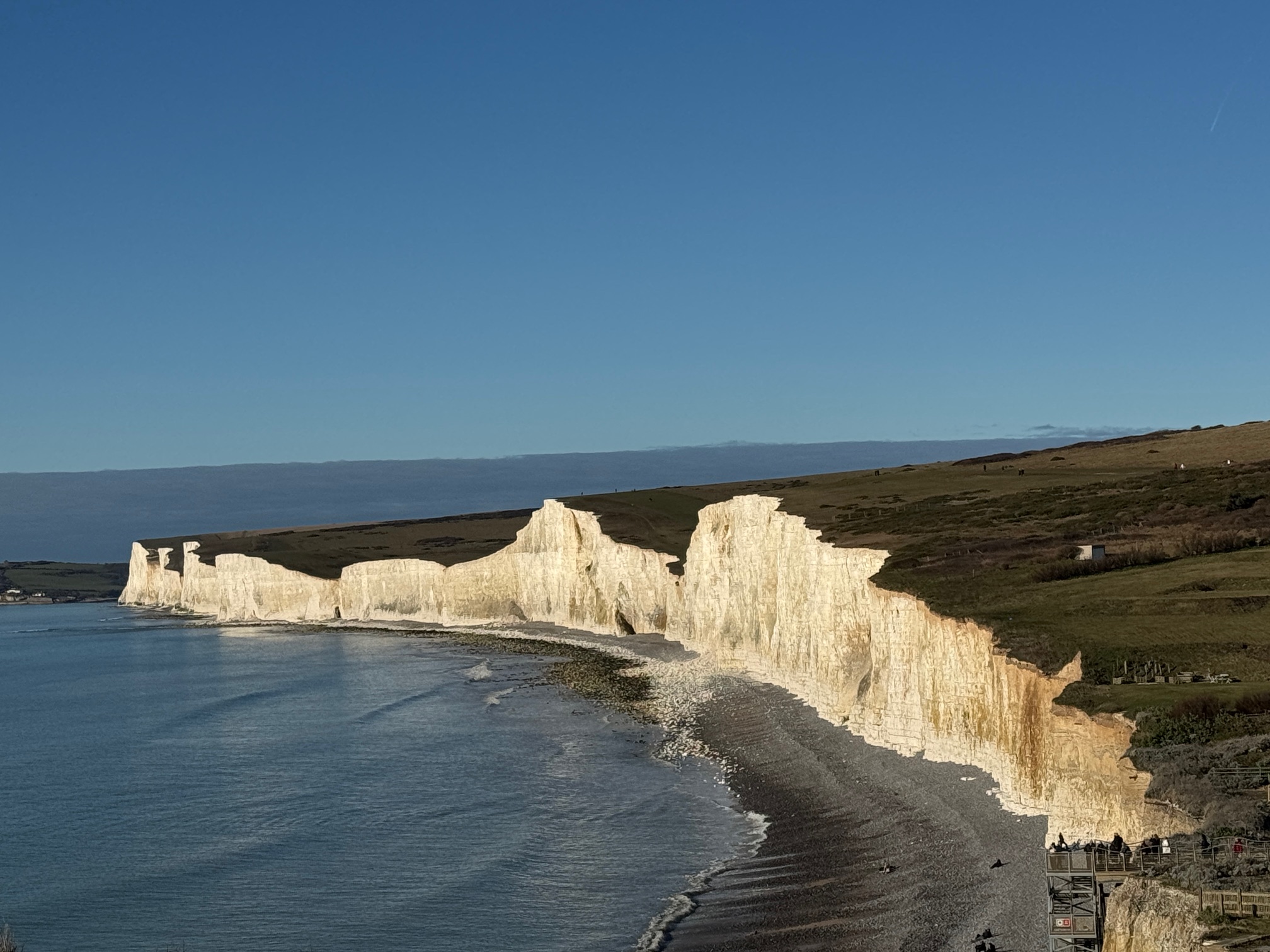
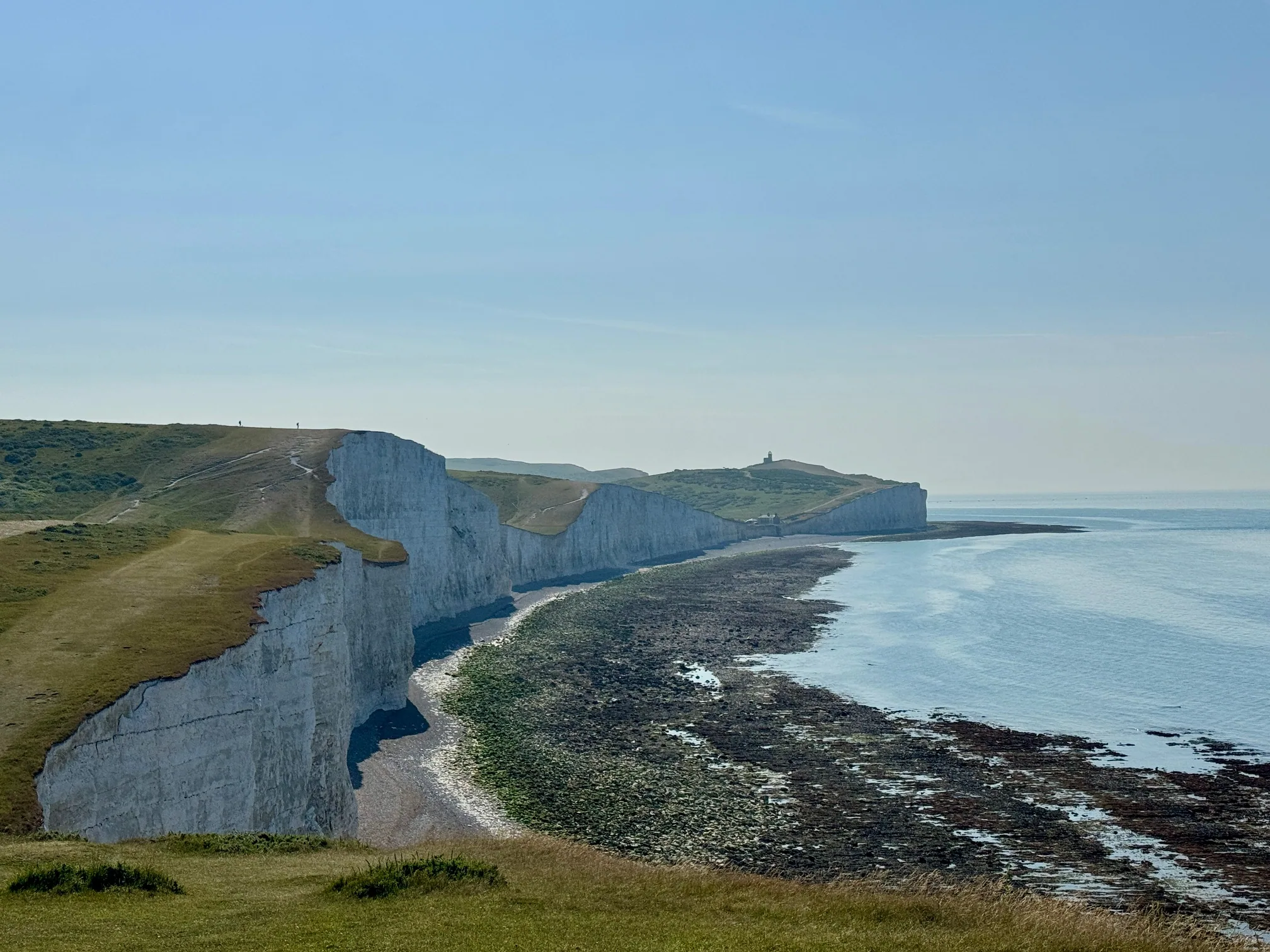
The view from 5 metres back is the same view as from the edge. The photography is the same photography. We have taken hundreds of photographs at Seven Sisters over the years and none of the good ones required standing within a metre of the drop. The famous shots — the long chalk wall stretching away, the meander at Cuckmere from above — are all taken from well back on the ridge. The edge does not give you a better shot. It gives you a dangerous one.
Children and dogs require specific mention. A child running toward the cliff edge at speed cannot be reliably stopped by an adult standing several metres away. A dog that has seen a seagull and is no longer interested in recall is a real and documented hazard. Keep both on short leads or within arm's reach in any section where the path runs close to the edge. This is not overcaution. It is the reason the HM Coastguard Birling Gap team runs annual awareness campaigns.
The chalk is more dangerous in wet weather and after rain. Saturated chalk erodes and collapses faster. Walking at the cliff edge immediately after heavy rain is asking the chalk to carry your weight at its most structurally vulnerable. The path also becomes slippery, which is a separate issue — a slip toward the edge on wet chalk is not recoverable the way a slip on a hill path is.
Wind matters too, in a way that people often underestimate. The cliff top is consistently 10–15 mph windier than inland — a "light breeze" by inland standards is a substantial wind on the ridge. Strong gusts on exposed peaks can physically push an adult. If you are standing within a metre of the edge when a 35 mph gust arrives, the physics are not in your favour.
Early morning after a night of frost is another elevated-risk window. Freeze-thaw cycles are one of the primary mechanisms of chalk weakening. The mornings after cold overnight temperatures in autumn and winter are not the time to be exploring near the cliff edge.
Call 999 and ask for the Coastguard. Not Mountain Rescue — Coastguard. They are the coordinating authority for cliff emergencies on this stretch of coast and will dispatch the appropriate response. State "Seven Sisters" clearly, give your best description of location (the nearest peak, landmark, or what3words if you have it), and stay on the line.
Do not attempt to descend the cliff face to reach someone below. The chalk is not climbable and the descent will create a second casualty. The Coastguard response time to most points on the Seven Sisters ridge is 20–40 minutes. Helicopter response from the Lydd or Henstridge coastguard helicopters can be faster.
If you witness a collapse without anyone involved, report it to the Birling Gap National Trust team or the Coastguard anyway. Fresh collapse zones change the safe walking distance requirements and others need to know.
Every season, people approach the cliff edge for photographs and every season some of them get hurt or cause alarm. The instinct to get as close as possible to the edge is understandable — the view downward at the chalk face is spectacular. But the cliff is also spectacular from a safe distance, and the photograph is not worth what can go wrong.
If you want low-angle cliff face shots, the beach at Birling Gap at low tide gives you a view upward from directly below — genuinely extraordinary, completely safe, and not available from the top. From the ridge, the best shots are the wide compositional ones — the long chalk wall extending west, the sky above the peaks, the meander at Cuckmere. None of these require standing within five metres of the edge. Most require standing well back to get the full compositional range in frame.
Seven Sisters is one of the fastest-eroding stretches of chalk coastline in England. The average figure — 30–50cm per year — conceals the real character of erosion here, which is episodic rather than gradual. The cliff does not steadily retreat. It holds, holds, holds, and then a section collapses suddenly, advancing the edge by several metres in seconds.
The mechanism is well-understood by geologists. Wave action at the cliff base creates a notch — an undercut that grows progressively deeper as each tide pounds the chalk face. Above the notch, the chalk maintains its form but is no longer fully supported. Meanwhile, rainwater infiltrates the chalk through a network of joints and bedding planes. In winter, that water freezes, expanding and prising apart the joints from the inside. When the chalk saturates after heavy rain, the pore pressure increases and the structural strength of the rock drops significantly.
The combination of undercut base, saturated chalk, and frost-widened joints produces what geologists call a "failure surface" — an invisible plane inside the rock along which collapse will eventually occur. There is no surface expression of this. The turf above it is intact. The chalk feels solid underfoot. The crack that will allow the section to fall may be a metre or more below the surface. This is precisely why the visual check — "it looks fine" — is not adequate.
What "invisible cracks" means in practice.
A chalk collapse at Seven Sisters typically involves a section 2–10 metres wide and 1–3 metres deep. It happens in seconds. The section above the undercut simply separates along the failure plane and falls. There is no warning — no cracking sound in advance, no visible change at the surface. People who have witnessed chalk collapses consistently describe the same thing: "it was fine, and then it wasn't." The 5-metre rule accounts for this. A collapse of 3 metres takes the edge 3 metres further inland. Five metres of separation is the minimum margin to remain clear of a typical collapse zone.
The erosion and collapse of chalk cliffs in Sussex is not a rare event. Between Seaford Head and Beachy Head — the stretch that includes Seven Sisters — significant collapses occur multiple times each year. The most documented recent example at Birling Gap is the coastguard cottages: a row of Victorian coastguard houses sat at what was then a safe distance from the cliff. Three have fallen into the sea since 2014. The National Trust has been managing the controlled demolition of the remaining structure as the cliff edge retreats to meet it.
In 2021, a large section of chalk collapsed on the beach below the Seven Sisters between Birling Gap and Cuckmere Haven, producing a debris field across the beach. In 2023, several collapse events on the Sussex coast were reported by the British Geological Survey. These are not exceptional events — they are the normal operating behaviour of chalk cliffs at this erosion rate.
The implication for visitors is practical: the specific location of the cliff edge changes. The safe distance from last summer may be slightly less safe this summer because the edge has moved. The 5-metre rule accounts for this by providing a buffer larger than any typical annual retreat.
The minimum safe distance is 5 metres from the visible cliff edge — and further is always better. Chalk at Seven Sisters is actively eroding and can collapse without warning. What looks like solid turf may have voids underneath from internal fractures. Treat 5 metres as an absolute minimum, not a target.
Chalk is porous and water infiltrates through joints and cracks below the surface. Freeze-thaw cycles, rain saturation, and wave undercutting from below weaken the rock internally. The overhang can look and feel stable while being structurally compromised. Collapses happen without any surface warning — sometimes of sections several metres across and deep.
Approximately 30–50 centimetres per year on average — one of the fastest erosion rates on the English chalk coastline. Three of the original Birling Gap coastguard cottages have fallen into the sea since 2014. The edge came to them, not the other way around.
There is no continuous fencing along the Seven Sisters cliff top. The path is managed by the National Trust and Natural England but is unfenced for conservation and practical reasons. Responsibility for staying a safe distance from the edge rests with the walker.
Chalk cliff collapses are caused by a combination of: wave undercutting of the cliff base, rainwater infiltrating internal joints, freeze-thaw cycles widening cracks from the inside, and the progressive development of unsupported overhangs. Collapses are most common after heavy rainfall, after frost periods, and in winter. There is typically no visible surface warning before a section falls.
The best photographs of Seven Sisters do not require approaching the cliff edge. The famous compositions are taken from well back on the ridge path. Moving closer introduces genuine safety risk without improving the image. The beach at Birling Gap at low tide gives an extraordinary upward view of the chalk faces — completely safe and more dramatic than the cliff-top perspective.
Yes. Fatal cliff falls at Seven Sisters and the adjacent Beachy Head area occur every year. HM Coastguard Birling Gap responds to cliff incidents on this stretch of East Sussex coast regularly and runs annual safety campaigns. The hazard is ongoing and real.
For the detailed science of why chalk cliffs collapse, see cliff collapse risk explained. For fog and visibility safety, see the fog safety guide. For emergency contacts and step-by-step instructions, see the emergency guide. For the full safety overview, see the safety hub.
The clifftop paths differ in how near the edge they run and how exposed they feel. Compare the four routes before you choose one.
Stay up to date with seasonal guides, crowd forecasts, and local tips — direct to your inbox.
No spam. Only coastal inspiration and timing tips — unsubscribe any time.