Seven Sisters
Solo Walking Safety
Thousands of people walk Seven Sisters alone every year. Here is how to do it properly.
Thousands of people walk Seven Sisters alone every year. Here is how to do it properly.
Seven Sisters is walkable solo — thousands of people do it safely every year. This is the honest guide to the specific risks involved and how to manage them properly.
Updated May 2026. Reflects guidance developed across multiple solo walks on this coast in varied conditions — winter low season, spring fog, and summer heat.
Any emergency: 999 → Coastguard (cliff/beach) or 999 → Ambulance (medical). Nearest A&E: Eastbourne DGH, BN21 2UD.
Quick Answer — Solo Walking at Seven Sisters
Yes, Seven Sisters is safe to walk alone — thousands of people do it every year. The one non-optional step is telling someone your plan: your route, your expected return time, and what to do if they haven't heard from you by a specific hour. Phone signal is reasonable on the ridge in clear conditions but can drop at the valley sections. Carry a fully-charged phone, 1.5L of water, and a downloaded offline map. The ridge path is well-marked and regularly used.
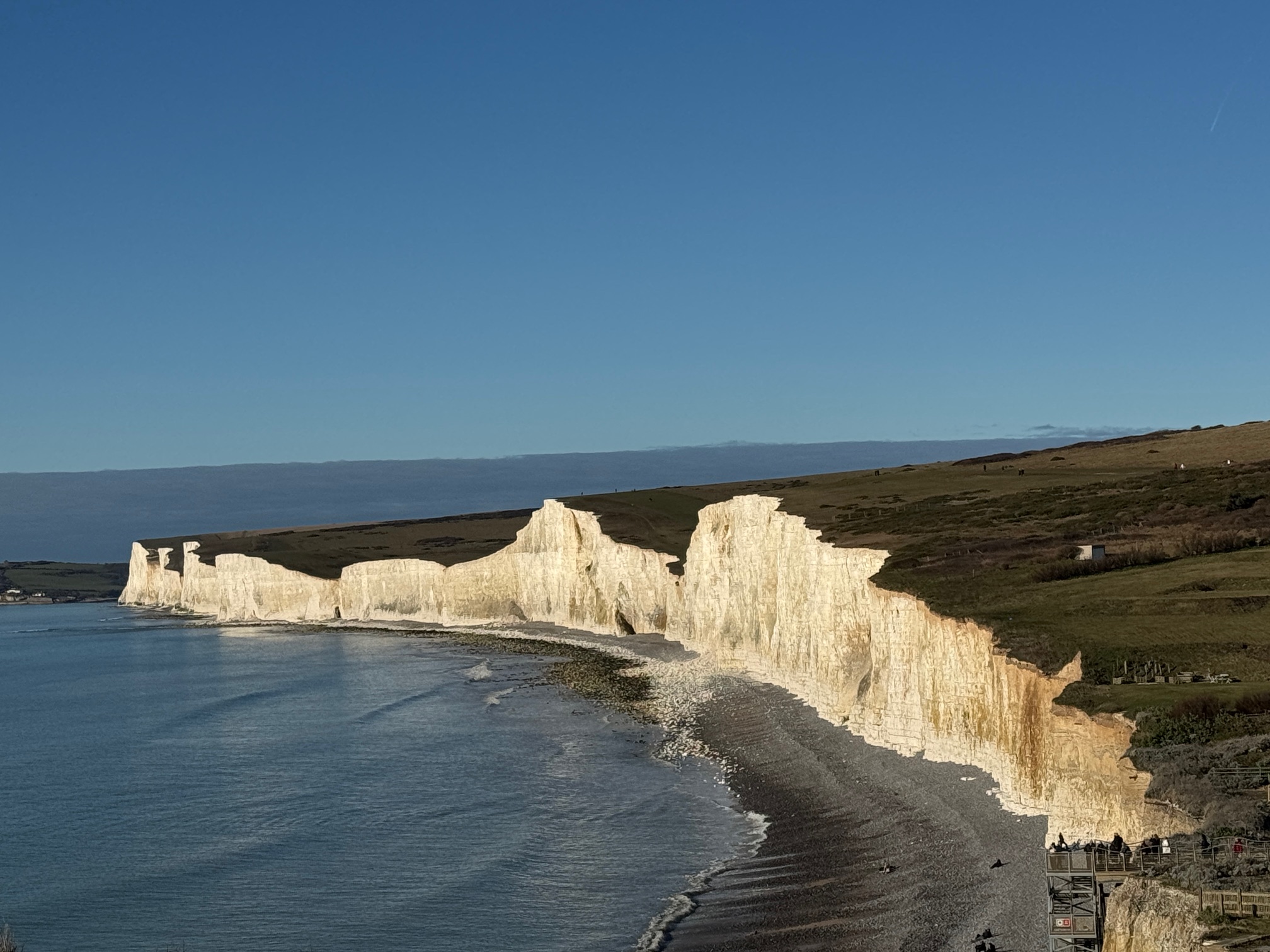
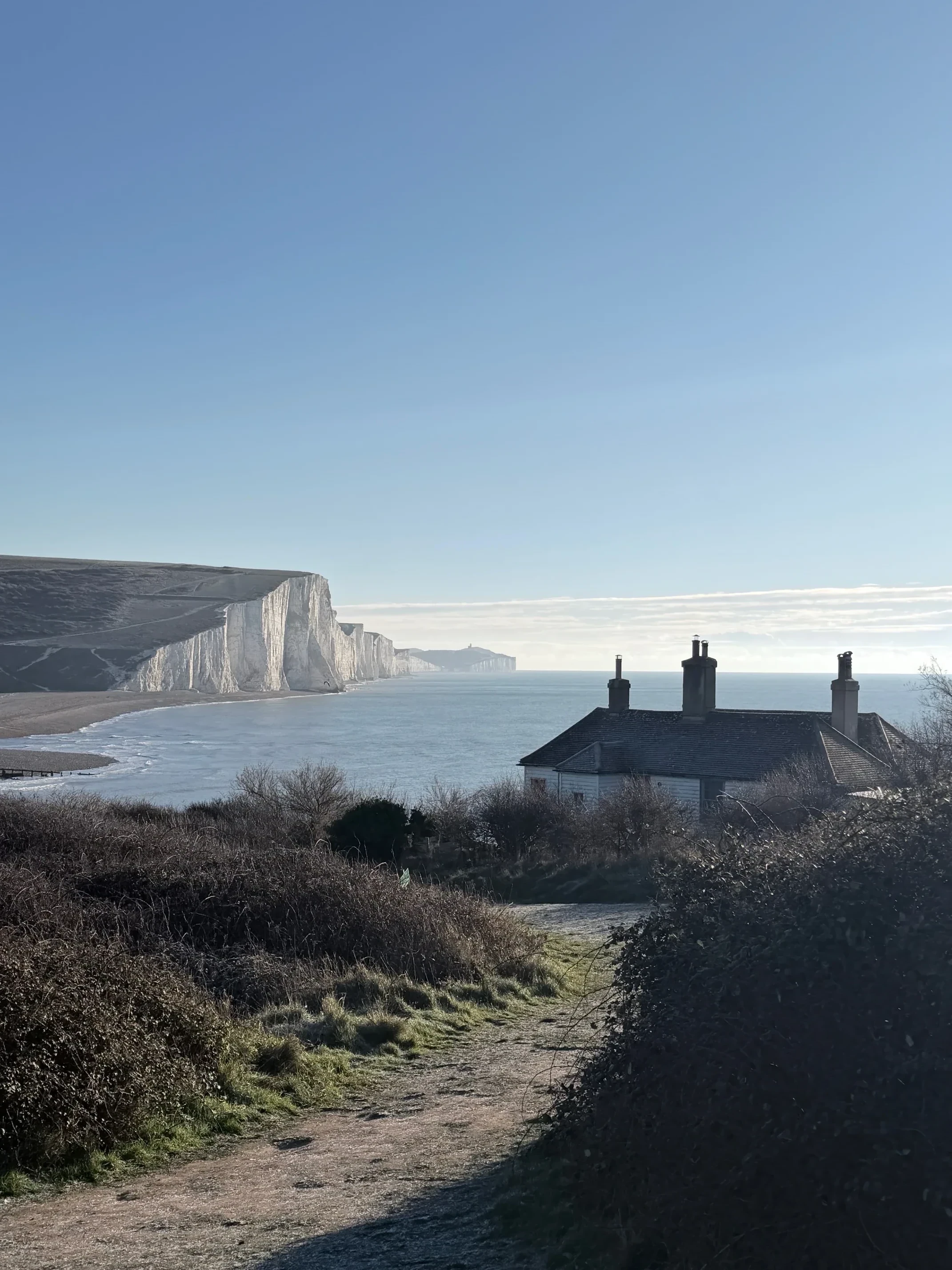
Let us get the main question out of the way: yes, you can walk Seven Sisters alone, and yes, it is a reasonable thing to do. The path is well-marked, used by hundreds of people on most days, and the terrain — while physically demanding — is not technical. Thousands of solo walkers complete this route every year without any incident.
The honest caveat is this: solo walking on cliff paths carries specific risks that group walking does not, and they are worth understanding before you go rather than after something has gone wrong. None of them are reasons not to go. All of them are manageable with straightforward preparation.
No one to get help if you are injured. A twisted ankle that is manageable with a group — one person stays, one goes for help — can become a serious situation alone. You are potentially 3–4km from the nearest car park in either direction, on paths that emergency vehicles cannot access, in an area with patchy mobile signal. A minor injury that would be an inconvenience with a group becomes a call to 999 if you cannot walk.
The practical answer to this is not to not go alone — it is to carry a fully charged phone, download your offline map before you leave, tell someone your route and expected return time, and carry a small first aid kit including a bandage and something for blisters. A walking pole is worth considering if you have knee or ankle history. Not because the terrain is extreme — it is not — but because a 6% grade descent on chalk after rain is slippery enough to catch anyone out.
No second set of eyes for changing conditions. When you are walking in a group, someone is almost always looking around while someone else is looking at the path. Alone, your attention is divided between watching where you are walking and watching what is happening around you — and the relevant conditions here change quickly. Sea fog can arrive in two minutes. Weather fronts accelerate over the Channel. What starts as a reasonable morning can change meaningfully within the time it takes to walk from one peak to the next.
The answer: build condition-checking into your walk deliberately. Every 20 minutes or so, stop, look behind you and at the horizon. If the sea-sky line has gone hazy, if the wind has changed direction, if the temperature has dropped noticeably — these are signals to start heading for the nearest exit point rather than continuing further along the ridge.
The temptation to take more risks. This one is less discussed but it is real. Without other people watching, the instinct to get a bit closer to the edge, to scramble somewhere you probably shouldn't, to push on when conditions are deteriorating — these tendencies are more likely to surface. Being aware of this is most of the solution. Solo walking on cliff paths calls for more conservatism than group walking, not less.
Tell someone where you are going and when you expect to be back. This is the single most important thing a solo walker can do, and it takes under a minute. It does not have to be complicated: "Walking Seven Sisters from Birling Gap to Cuckmere and back. Setting off at 10am, back by 2pm. If I'm not home by 4pm and not answering my phone, call 999 and tell them where I was walking."
That information — starting point, route, expected return — is what allows search and rescue to begin in the right place. Without it, a missing person report at Seven Sisters produces a search that covers 21.9km of cliff path and surrounding countryside. With it, they know where to start.
If you are walking alone regularly and find this conversation awkward, the alternative is to register your walk with a service like the Dartmoor Rescue Group's online walk registration (they cover non-Dartmoor walks), or simply text yourself the details and share the text thread with someone.
On a clear day with no fog risk and settled wind, any of the standard Seven Sisters routes is appropriate for solo walking. The most solo-friendly starting point is Birling Gap: it has the best parking, the nearest visitor facilities, good mobile signal, and allows you to walk as far as you choose and turn back to the same point without committing to a one-way route that requires transport at the other end.
The Seaford to Birling Gap route (or vice versa) is a more committing walk solo because you end at a different point to where you started, which requires pre-arranged transport or a bus journey back. It is fine to do alone — many solo walkers do it — but it adds a logistical variable worth planning in advance.
The conditions we would avoid solo: dense sea fog, winds above 25 mph (your forecast will show this, though the actual ridge speed will be higher), wet chalk after heavy rain, or very early morning or late evening when the path is quieter. None of these are absolute rules, and all depend on experience. But if you are doing this walk alone for the first time, clear settled conditions in the middle of the day — when there are other walkers around and the café is open — is the right choice.
More than you would in a group. The margins are smaller alone, so the kit needs to compensate. Nothing excessive — this is a day walk on maintained paths — but more deliberate than a group trip where others fill in the gaps.
Minimum solo kit: phone fully charged (and a small USB power bank if you have one), offline map downloaded before you leave, water — more than you think, 1.5L minimum — a layer accessible in your bag rather than buried at the bottom, food for the full duration, a small first aid kit (blister plasters, bandage, pain relief), and ideally a foil emergency blanket (they weigh nothing and cost £2). If you wear boots with ankle support rather than trainers, the risk of a turned ankle — the most common solo-relevant injury on this terrain — drops significantly.
Yes — Seven Sisters is safely walkable solo and thousands of people do it every year without incident. Solo walking on cliff paths carries specific risks (no one to fetch help if injured, no second pair of eyes for changing conditions), but these are manageable. The essentials: tell someone your route and return time, carry a fully charged phone with an offline map, stick to the main path, and keep further back from the cliff edge than you would in a group.
Before leaving: tell someone your starting point, planned route, and expected return time. Download an offline map (OS Maps or Komoot) and confirm it works without signal. Check your phone is fully charged. Pack 1.5L water, a mid-layer in the top of your bag, a small first aid kit, and food for the full duration. Check the weather forecast and, in late spring and summer, note the sea fog risk before heading to the ridge.
Call 999 and ask for the Coastguard (cliff path or beach emergencies) or Ambulance (medical). A twisted ankle that would be minor in a group can become a serious situation alone — emergency vehicles cannot access the cliff path, and the nearest car park may be 3–4km away. This is why carrying a first aid kit, wearing boots with ankle support, and telling someone your plan are all more important when walking alone than in a group.
One message, under a minute: your starting point, your planned route, your expected return time, and what to do if they haven't heard from you. For example: "Walking Seven Sisters from Birling Gap to Cuckmere and back. Setting off at 10am, home by 2pm. If I'm not back by 4pm and not answering my phone, call 999 and tell them where I was walking." This gives search and rescue the information they need to start in the right place.
No — signal is patchy and unreliable on the Seven Sisters ridge. It is generally available in the car parks at Birling Gap and Exceat, and on exposed ridge peaks in clear conditions. It is often absent in the dips between peaks and in the Cuckmere valley. EE and O2 have the best coverage. Download an offline map before you leave. Register your phone for text-999 before your walk - text the word "register" to 999 and follow the reply - this lets you text 999 where voice calls cannot connect (the old emergencysms.net website has closed).
Birling Gap is the best starting point for solo walkers. It has the strongest mobile signal on the east end of the ridge, parking, the National Trust café, and allows an out-and-back route of any length without committing to transport at the far end. A first solo walk from Birling Gap to the first or second peak and back is 3–4km and entirely manageable. Choose clear settled conditions, mid-morning, when other walkers are present and the café is open.
For occasional day walks on the Seven Sisters ridge, a PLB is not required but is a sensible addition for anyone walking alone regularly. A PLB transmits your GPS coordinates to emergency services via satellite when activated — it works without mobile signal. They cost from around £100 and are worth considering if you walk in more remote conditions or in fog-risk months. For the Seven Sisters specifically, registering your phone for text-999 (text "register" to 999) and carrying an offline map achieves much of the same protection at no cost.
For route options and distances from each starting point, see our walk duration guide. For the full safety overview including emergency contacts, see the safety hub. For what to do when fog arrives, see the fog safety guide.
Distance, phone signal and how busy the path stays all vary between the four routes. Compare them before setting off on your own.
Stay up to date with seasonal guides, crowd forecasts, and local tips — direct to your inbox.
No spam. Only coastal inspiration and timing tips — unsubscribe any time.