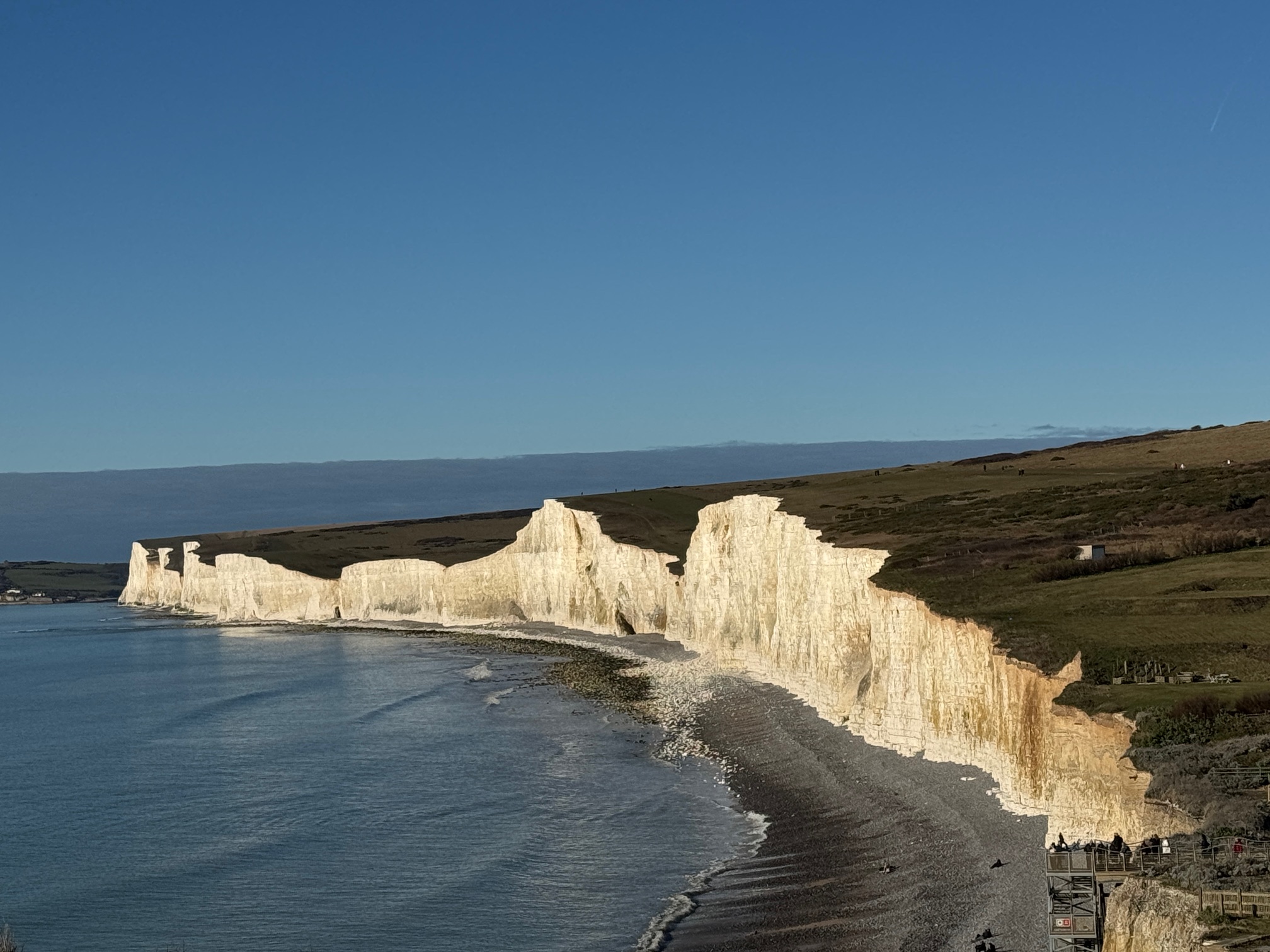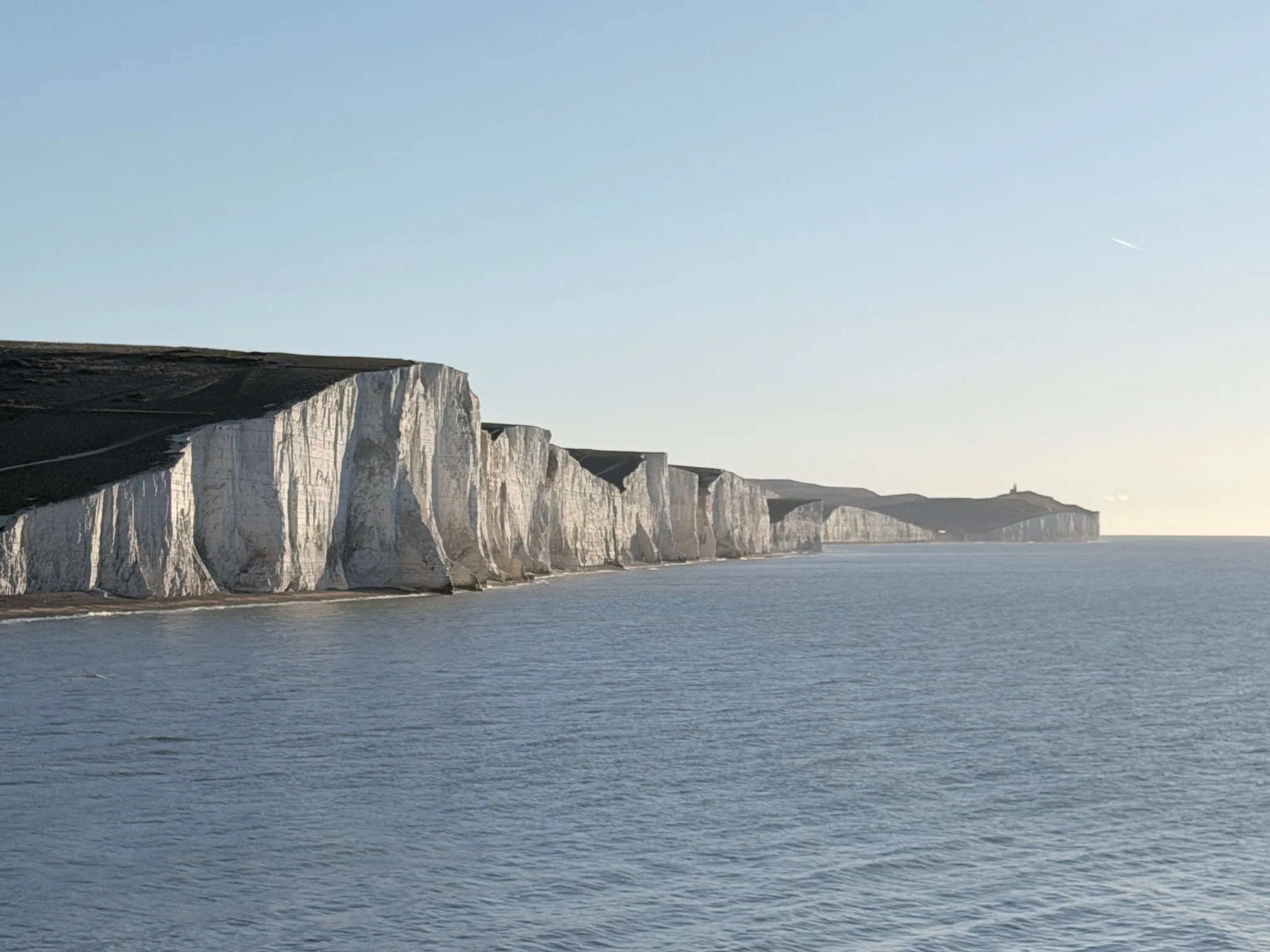
Seven Sisters
Emergency Guide
Who to call, what to say, where to go — specific to this stretch of coast.
Who to call, what to say, where to go — specific to this stretch of coast.
The specific information you need before you walk — who to call, what to say, where the nearest help is, and what to do in each type of emergency on this stretch of coast.
Updated May 2026. Written after walks during winter storms, spring fog events and summer heat conditions on this stretch of coast.
The Essentials — Read Before You Walk
Cliff / beach / sea emergency
999 → ask for Coastguard
State "Seven Sisters" clearly. Give your location: nearest landmark, peak number, or what3words location.
Medical emergency on trail
999 → ask for Ambulance
Ambulance response to this area can be 25–45 minutes. Coastguard can coordinate helicopter response faster in serious cases.
Nearest A&E
Eastbourne District General Hospital
Kings Drive, Eastbourne, BN21 2UD — approximately 20 minutes by car from Birling Gap.
Second nearest A&E
Princess Royal Hospital, Haywards Heath
RH16 4EX — approximately 50 minutes from Birling Gap. Use only if Eastbourne DGH is unavailable.
Non-emergency medical advice
111
Sprains, minor injuries, general health concerns that are not immediately life-threatening.
A cliff emergency means anyone has fallen or is at immediate risk of falling — including someone too close to the edge in dangerous conditions, or someone who has fallen to the beach below. The steps are the same regardless of the specifics.
Step 1: Move yourself to safety first. If you are near the cliff edge in wind or fog, move inland before doing anything else. You cannot help anyone if you become a second casualty. Get to a stable position away from the edge, on the marked path.
Step 2: Call 999 and ask for Coastguard. Not Mountain Rescue. Not Ambulance (though a Coastguard call will involve Ambulance where needed). The Coastguard is the coordinating authority for all cliff rescues on this stretch of East Sussex coast. HM Coastguard Birling Gap is the local station. They will ask: what has happened, how many people are involved, your location, and whether anyone is in the water.
Step 3: Give your location as precisely as you can. The what3words app (free, downloadable before your walk, works offline) gives a three-word location accurate to 3 metres. Birling Gap car park is ///chefs.tapes.flung. If you don't have it: "halfway between Birling Gap and the first peak, on the ridge path" is useful. "Near the cliffs" covers 7 kilometres. Name the nearest feature: Belle Tout Lighthouse, Birling Gap, the Cuckmere river mouth, Exceat farmhouse.
Step 4: Stay on the line. The call operator will guide you. If someone has fallen to the beach, do not attempt to climb or descend the cliff to reach them — this creates a second emergency every time it is attempted. Stay where you are. Coastguard ground response time is typically 20–40 minutes. Helicopter response is often faster in life-threatening situations.
Step 5: Keep the injured person warm and still. If someone has fallen on the path, keep them as still as possible. Any fall from height or heavy impact means a possible spinal injury — no movement until paramedics assess them. Cover with any available clothing or a foil blanket. Shock causes rapid heat loss even on warm days.
HM Coastguard operates rescue helicopter assets that can be dispatched in serious emergencies at Seven Sisters. Understanding how they work helps you assist when one arrives.
The helicopter typically cannot land on the Seven Sisters ridge — the terrain is uneven, the grass conceals dips and hollows, and cliff proximity makes most sections unsuitable for landing. The operational method is winching: a rescue operator descends on a wire to the casualty, stabilises them, and they are winched back up together. This process requires a clear area of at least 30 metres radius, free of people, ropes, and loose items that could be caught in the downwash.
If a helicopter is dispatched: the 999 operator will tell you. Your tasks are to keep all bystanders clear of a wide area around the casualty, remove any loose clothing or equipment that might blow away, and make yourself visible so the crew can see you. Wave once, clearly — do not continuously wave as it makes it difficult for the crew to identify the actual casualty location.
On the beach below the cliffs, a helicopter winch rescue is simpler — the beach provides a clear operational area. Keep everyone clear of the area where the casualty is positioned.
The RNLI (Royal National Lifeboat Institution) covers maritime emergencies in the sea and on the beach below the Seven Sisters cliffs. The nearest RNLI stations are at Eastbourne (lifeboat) and Newhaven (lifeboat). If someone is in the water, or stranded on a section of beach that is only accessible by sea, the Coastguard (999) will coordinate an RNLI response.
HM Coastguard handles the cliff-top and cliff-base rescue coordination — including any incident involving the chalk cliff faces, the ridge path, and the beach at Birling Gap and Cuckmere Haven. Always call 999 and ask for Coastguard as your first action. They will involve the RNLI, Ambulance, or other services based on what the situation requires.
Signal is patchy and unreliable across the Seven Sisters ridge. This is not the sort of countryside where you can rely on calling 999 from any given point. The honest picture (see the full phone signal and offline navigation guide for where it drops and how to prepare):
Signal is generally available in the car parks at Birling Gap and Exceat, and on the elevated ridge peaks on clear days. It is often unavailable in the dips between peaks, in the Cuckmere valley, and anywhere below the cliff line. EE and O2 tend to have the strongest coverage on this stretch; Vodafone and Three are more variable. If you have multiple phones in your group on different networks, the better coverage may differ by location.
If your call is dropping: move to the highest nearby point (elevation improves signal), move toward Birling Gap car park (strongest signal zone on the east end), or try SMS — texts sometimes succeed when voice calls cannot. The emergency text service requires pre-registration.
Register for emergency SMS before your walk.
Text the word "register" to 999 and follow the reply. This takes about a minute. Once registered, text "999" followed by your message and location in situations where voice calls cannot connect. The registration is permanent (re-register only if you change your number) and works across all UK emergency services. Do this before you leave - the old emergencysms.net registration website has closed.
Sea fret can arrive at Seven Sisters in under two minutes and reduce visibility to single figures on the ridge. Most people's first response to sudden fog is to keep walking and hope it clears. On the Seven Sisters ridge, this is the wrong response.
If visibility drops significantly: stop where you are. Do not continue walking based on the direction you were heading — your sense of direction degrades in fog faster than you expect. Establish your position on an offline map before moving. Moving in the wrong direction on the ridge in zero visibility means the cliff edge could be anywhere.
If visibility is above 20 metres and you are certain of your position relative to the cliff edge: continue carefully toward your nearest exit, keeping to the marked path. If visibility drops below 20 metres: stop, establish position, and move only in a direction you are certain is inland and away from the cliff edge. The sound of the sea is useful but not reliable as a direction guide in fog — sound travels unpredictably in mist.
If you are completely disoriented in fog on the ridge: stay still, stay warm, and call 999. Do not attempt to navigate by feel in the direction you think is inland. Fog on this coast can be patchy — a few hundred metres of movement may take you out of it, or deeper into it.
Fog rule of thumb on the Seven Sisters ridge:
Walking the Seven Sisters ridge at night is legal but carries significantly higher risk than daytime walking. The cliff edge is invisible in darkness and the path is difficult to follow without a powerful torch. Most cliff incidents involving night walkers involve disorientation — the inability to judge distance from the edge, or walking off the path and realising too late that the ground has changed.
If you are walking at night deliberately: use a powerful head torch with fresh batteries, download an offline map and keep it visible throughout, tell someone your route and return time, and walk in a group. Stay farther from the cliff edge than you would in daylight — your margin for error is smaller.
In winter, the risk increases further: wind chill at night on an exposed chalk ridge significantly accelerates heat loss. The combination of cold, darkness and disorientation is what makes the ridge genuinely dangerous after dark. Winter sunset at Seven Sisters occurs as early as 3:50pm — walkers who start the full ridge route in early afternoon and underestimate pace can find themselves in failing light before reaching their exit point.
Winter sunset times at Seven Sisters (approximate):
Start all full ridge routes by 10am in December and January. Allow 4 hours minimum for Birling Gap to Cuckmere and back.
This is an important practical reality. Emergency vehicles cannot access most of the Seven Sisters cliff ridge. There is no road access to the ridge between Birling Gap and Exceat. The cliff-top path is pedestrian only. Ambulances and coastguard vehicles can reach Birling Gap car park from the east and Exceat car park from the west — but the 6-kilometre ridge between them requires the rescue team to walk, ride a quad bike (coastguard only), or use helicopter access.
This means: if you call 999 from the middle of the ridge, the response time is longer than if you are near either car park. It also means that for serious injuries, a helicopter evacuation is often the fastest option even when it seems dramatic.
The practical implication for planning: if someone in your group has a condition that makes rapid medical evacuation important — a heart condition, severe allergy, mobility issues — starting and ending at one of the car parks keeps you within the fastest emergency access zone.
The single most important preparation for solo walkers: tell someone your route and expected return time before you leave. "Walking Birling Gap to Cuckmere and back, starting 10am, back by 1pm." Send it as a message. If you are not back and not contactable at your stated time, that person can call 999 and give search and rescue exactly what they need to know: where to start looking.
Also: download what3words before leaving (works offline), carry a fully charged phone and consider a small power bank, and know that Birling Gap visitor centre has first aid on busy days. The solo walking guide covers all of this in more detail.
Children near cliff edges need to be within arm's reach — this is not overcaution but a response to the unpredictable movement of excited children and the specific consequence of a stumble toward the cliff edge. Keep children on the inland side of you on cliff-top sections.
Carry more water than you think you need — children dehydrate faster than adults and are less reliable reporters of thirst. Know your exit options at all times: the cliff top is never more than a few hundred metres from a descent into one of the dry valleys.
If a child falls on the path and the impact was significant, treat it as a possible spinal injury and call 999. Do not lift or move them until instructed by paramedics.
Photography is consistently cited in cliff-edge incidents at Seven Sisters. The desire for a better shot creates a systematic incentive to approach the edge more closely than is safe. The best-known photographs of Seven Sisters — the ones used in tourism campaigns and on book covers — are taken from well back on the path, from the beach at low tide, or from a viewpoint across the Cuckmere valley. The cliff-edge viewpoint does not produce the best compositions.
If you are photographing at dawn or dusk, the light is extraordinary but visibility changes fast. Never approach the edge in low light. The beach at Birling Gap at low tide gives an upward view of the chalk faces that is genuinely spectacular and completely safe.
If someone is injured on the ridge and cannot walk: keep them warm, keep them still if the injury involved a fall, and call 999 immediately — do not wait to see if they improve. A twisted ankle mid-ridge means a 20–40 minute wait for coastguard assistance even in good conditions. In poor conditions or near the cliff edge, the wait is the safer option compared to attempting to assist someone whose injury you cannot fully assess.
If you are caught on the Seven Sisters ridge in a strengthening storm:
Get off the exposed cliff top immediately — descend into the nearest dry valley (the Cuckmere valley to the west, or the gap at Birling Gap to the east) and continue on the valley path. The valley floor is significantly more sheltered than the ridge in high winds.
In gusts above 40 mph on the exposed ridge, maintain a very wide margin from the cliff edge — gusts at this level can physically unbalance walkers, and the effect is greater closer to the edge where the wind accelerates as it passes the cliff top. Get low, keep your pack weight centred, and move at a steady, controlled pace toward your exit. Do not run in strong gusts near the cliff edge.
If lightning accompanies the storm: avoid isolated trees. Get away from the highest points on the ridge. Move into the valley and shelter from the lightning — not from the wind — as the priority.
Check the weather before you leave: inland forecasts routinely understate wind speeds on the exposed chalk ridge by 8–15 mph. A "15 mph breeze" forecast can mean 25–30 mph sustained with gusts on the ridge tops. See the weather safety guide for how to read coastal conditions correctly.
The Seven Sisters ridge has zero shade for 6 kilometres. Chalk reflects UV upward from below as well as downward from above. The café at Birling Gap runs out of water on hot days — sometimes before 1pm. In a heatwave, heat exhaustion is a genuine risk, particularly for visitors who have driven down from London and walked straight onto the ridge in midday heat.
Signs of heat exhaustion: heavy sweating, pale skin, fast pulse, dizziness, weakness, nausea, headache. If someone shows these signs, move them immediately to the most shaded position available (a dry valley descent provides some relief), lay them down with legs elevated, and give water in small, frequent sips if they are conscious and able to swallow.
Call 999 if: they are confused or cannot respond normally, they lose consciousness, they stop sweating despite continuing heat, or they do not improve significantly within 30 minutes. Heat stroke — the serious progression from heat exhaustion — is a medical emergency.
The practical heatwave rule: carry 2L of water per person minimum. Start early (before 9am) to complete the main ridge before the hottest part of the day. Do not dismiss heat symptoms as tiredness. See the heat and sun safety guide for full detail.
The beach at Birling Gap and Cuckmere Haven disappears at high tide. The sea reaches the cliff base. People get stranded every year — more frequently than cliff falls. If you are on the beach and the water is rising and you cannot get back to the steps or the path, call 999 and ask for the Coastguard immediately. Do not wait until it is critical.
Do not attempt to climb the chalk cliff face. The chalk is not climbable and this creates a second emergency every time it is attempted. The Coastguard can reach the beach from above, from the water, and by helicopter. Your job is to stay on the beach, move to the highest available point, and keep your phone dry while you call.
If someone is in the water in difficulty: call 999 (Coastguard) and throw anything buoyant if available. Do not enter the water yourself. The currents below the Seven Sisters cliffs are unpredictable and strong, particularly around the cliff bases at Birling Gap.
This takes five seconds and we cannot overstate how important it is. Before any walk at Seven Sisters, tell one person who is not coming: your starting point, your planned route, and your expected return time.
"Walking Birling Gap to Cuckmere and back, starting at 10am, back by 1pm."
That is the whole message. If you are not back and not contactable by your stated time, that person can call 999 with the information that rescuers actually need to start a search: where you began, what route you planned, and when you should have been back. Without this information, a search has no starting point.
Call 999 and ask for the Coastguard for any cliff, beach or sea emergency. For medical emergencies on the trail, 999 and ask for Ambulance. HM Coastguard Birling Gap is the local rescue coordination point covering this stretch of East Sussex coast.
Eastbourne District General Hospital, Kings Drive, Eastbourne, BN21 2UD — approximately 20 minutes by car from Birling Gap. A&E is open 24 hours. The second nearest is Princess Royal Hospital, Haywards Heath, RH16 4EX (approximately 50 minutes).
Patchy and unreliable across much of the ridge. EE and O2 have the strongest coverage. Car parks at Birling Gap and Exceat generally have signal. The ridge between peaks and the Cuckmere valley often do not. Download offline maps and register your phone for text-999 before your walk - text the word "register" to 999 and follow the reply (the old emergencysms.net website has closed).
Coastguard helicopters typically cannot land on the ridge — the terrain is unsuitable. Rescues involve winching: a rescue operator descends to the casualty and winches them up. Keep a wide, clear area around the casualty. Wave once clearly to indicate location, then stop waving so the crew can locate the casualty precisely.
Stop immediately. Establish your position on an offline map. Move inland and slightly uphill — away from the sound of the sea. Below 20-metre visibility, do not navigate by feel. Below 10-metre visibility near the cliff edge, stay still and call 999. Fog at Seven Sisters can arrive in under two minutes and reduce visibility to near zero.
Call 999 immediately and ask for the Coastguard. Move to the highest point of the beach. Do not climb the chalk cliff — it is not safely climbable. Stay on the beach, keep your phone dry, and wait for rescue. The Coastguard can reach you from above, by sea, or by helicopter.
The RNLI covers maritime emergencies in the sea below and around the Seven Sisters cliffs. Nearest stations are at Eastbourne and Newhaven. If someone is in the water, the Coastguard (999) will coordinate an RNLI response. The RNLI does not respond to cliff-top emergencies — that is HM Coastguard.
Yes — but only if you have registered your phone in advance. Text the word "register" to 999 and follow the reply; registration takes about a minute and is permanent (re-register only if you change number). Once registered, text "999" followed by your message and location. Texts sometimes succeed where voice calls cannot connect. Register before your walk, not during an emergency - the old emergencysms.net website has closed.
Legal, but significantly higher risk than daytime. The cliff edge is invisible in darkness and path-following is difficult without a powerful torch. If you walk at night, carry a head torch with fresh batteries, use an offline map throughout, tell someone your route, and keep well back from the cliff edge. In winter, sunset can be as early as 3:50pm — time your walks to finish before dark.
Carry 2L of water per person minimum — the café at Birling Gap sells out on hot days. There is no shade for 6km on the ridge. If someone shows signs of heat exhaustion (heavy sweating, pale skin, fast pulse, dizziness), move them to shade, lay them down, give water in small sips, and call 999 if they do not improve within 30 minutes or show confusion.
For cliff edge safety rules and erosion risk, see cliff edge safety. For fog and visibility decision-making, see the fog safety guide. For weather forecasting on this coast, see the weather safety guide. For the full safety overview, see the safety hub. For the geology of why chalk cliffs collapse, see cliff collapse risk explained.
Giving your route and nearest landmark is the fastest way to be located on this coast. Compare the four routes and their access points before you walk.
Stay up to date with seasonal guides, crowd forecasts, and local tips — direct to your inbox.
No spam. Only coastal inspiration and timing tips — unsubscribe any time.